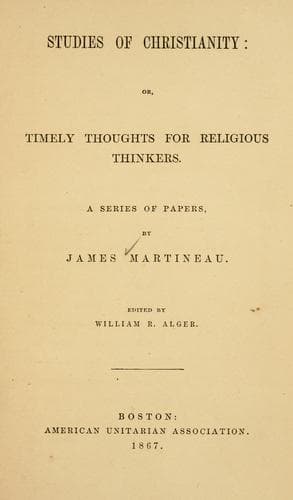
Studies of Christianity; Or, Timely Thoughts for Religious ThinkersMartineau, James
Religion
Studies of Christianity; Or, Timely Thoughts for Religious Thinkers
Martineau, James
Christianity; Church history -- 19th century
Here, then, is a fearful contradiction between the religion of
conscience and the religion of the understanding; the one pronouncing
evil to be the antagonist, the other to be the agent, of the Divine
will. In every age has this difficulty laid a heavy weight upon the
human heart; in every age has it pointed the sarcasm of the blasphemer,
mingled an occasional sadness with the hopes of benevolence, and tinged
the devotion of the thoughtful with a somewhat melancholy trust. The
whole history of speculative religion is one prolonged effort of the
human mind to destroy this contrariety; system after system has been
born in the struggle to cast the oppression off,--with what result, it
will be my object at present to explain. The question which we have to
consider is this, "How should a Christian think of the origin and
existence of evil?" I propose to advert, first, to the speculative;
secondly, to the scriptural; thirdly, to the moral relations of the
subject; to inquire what relief we can obtain from philosophical
schemes, from biblical doctrine, and from practical Christianity.
* * * * *
Let us then, for final decision, consult the practical spirit of
Christianity, and ascertain to what view of the origin of sin it
awards the preference. Is it well for the consciences and characters
of men, to consider God--either directly or through his dependant,
Satan, either by his general laws or by vitiating the constitution of
our first parents--as the primary source of moral evil? _or_, on the
contrary, to regard it as in no sense whatever willed by the Supreme
Mind, and absolutely inimical to his Providence? Are we most in
harmony with the characteristic spirit of the Gospel when we call sin
his instrument, or when we call it his enemy? For myself, I can never
sit at the feet of Jesus, and yield up a reverential heart to his
great lessons, without casting myself on the persuasion, that God and
evil are everlasting foes; that never, and for no end, did he create
it; that his will is utterly against it, nor ever touches it, but with
annihilating force. Any other view appears to be injurious to the
characteristic sentiments, and at variance with the distinguishing
genius, of Christian morality.
Public-domain text, read in full here on John Shaqi.
Reviews
Reviews
No reviews yet
Be the first to share your thoughts on this work.
Join the Discussion
Join the discussion
Sign in to leave a comment or review.
Sign InorCreate an account