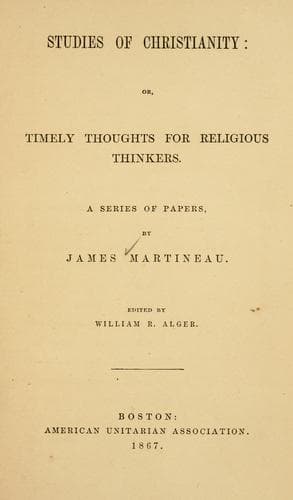
Studies of Christianity; Or, Timely Thoughts for Religious ThinkersMartineau, James
Religion
Studies of Christianity; Or, Timely Thoughts for Religious Thinkers
Martineau, James
Christianity; Church history -- 19th century
(1.) Christianity is distinguished by the profound sentiment of
_individual responsibility_ which pervades it. All the arbitrary forms,
and sacerdotal interpositions, and hereditary rights, through which
other systems seek the Divine favor, are disowned by it. It is a
religion eminently _personal_; establishing the most intimate and
solitary dealings between God and every human soul. It is a religion
eminently _natural_; eradicating no indigenous affection of our mind,
distorting no primitive moral sentiment; but simply consecrating the
obligations proper to our nature, and taking up with a divine voice the
whispers, scarce articulate before, of the conscience within us. In this
deep harmony with our inmost consciousness of duty resides the true
power of our religion. It subdues and governs our hearts, as a wise
conqueror rules the empire he has won; not by imposing a system of
strange laws, but by arming with higher authority, and administering
with more resolute precision, the laws already recognized and revered.
To trifle in any way with this plain and solemn principle, to invent
forms of speech tending to conceal it, to apply to moral good and ill
language which assimilates them to physical objects and exchangeable
property, implies frivolous and irreverent ideas of sin and
excellence. The whole weight of this charge evidently falls on the
scheme which speaks of human guilt as an hereditary entail; a scheme
which shocks and confounds our primary notion of right and wrong, and,
by rendering them impersonal qualities, reduces them to empty names.
No construction can be given to the system, which does not pass this
insult on the conscience. In what sense do we share the guilt of our
progenitor? His concession to temptation did not occur within our
mind, or belong in any way to our history. And if, without
participation in the _act_ of wrong, we are to have its _penalties_,
crimes in the planet Saturn may be expected to shower curses on the
earth; for why may not justice go astray in space, as reasonably as in
time? If nothing more be meant, than that from our first parents we
inherit a constitution _liable_ to intellectual error and moral
transgression,--still it is evident that, _until_ this liability takes
actual effect, no sin exists, but only its possibility; and _when_ it
takes effect, there is just so much guilt, and no more, than might be
committed by the individual's will: so that where there is _no_
volition, as in infancy, cruelty only could inflict punishment; and
where there is _pure_ volition, as in many a good passage of the
foulest life, equity itself could not withhold approval.
Public-domain text, read in full here on John Shaqi.
Reviews
Reviews
No reviews yet
Be the first to share your thoughts on this work.
Join the Discussion
Join the discussion
Sign in to leave a comment or review.
Sign InorCreate an account