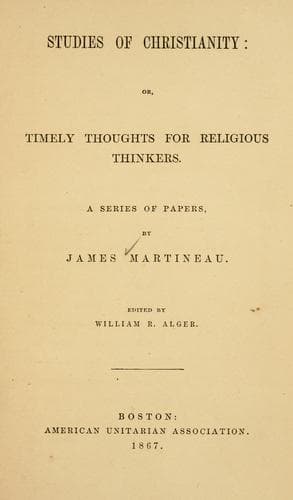
Studies of Christianity; Or, Timely Thoughts for Religious ThinkersMartineau, James
Religion
Studies of Christianity; Or, Timely Thoughts for Religious Thinkers
Martineau, James
Christianity; Church history -- 19th century
In Devotion there is this great peculiarity,--that it is neither the
_work_ nor the _play_ of our nature, but is something higher than
either,--more ideal than the one, more real than the other. All human
activities besides are one of these two things,--either the mere aim
at an external end, or the mere outcome of an inner feeling. On the
one hand, we plough and sow, we build and navigate, that we may win
the adornments and securities of life; on the other hand, we sing and
dance, we carve and paint, that we may put forth the pressure of
harmony and joy and beauty breaking from within. Mechanical Toil
terminates in a solid product; graceful Art is content with simple
expression; but Religion is degraded when it is reduced to either
character. It is not a labor of utility; and he who looks to it as a
means of safety, to ingratiate himself with an awful God, and bespeak
an interest in a hidden Future, is an utter stranger to its essence;
his habits and words may be cast in its mould, but the spark of its
life is not kindled in his heart. When fed by the fuel of prudence,
the fire is all spent in fusing it into form; and the finished product
is a cold and metal mimicry, that neither moves nor glows. Nor is
Religion a simple gesture of passion; and to class it with mere
natural language, to treat it as the rhythmical delirium of the soul
working off an irrepressible enthusiasm, is to empty it of its real
meaning and contents, and sink it from a divine attraction to a human
excitement. The postures and movements and tones which simply
manifest the impassioned mind are content to go off into space, and
pass away; they direct themselves nowhither; they have no more
_object_ than a convulsion; they ask only leave to be the last shape
of a feeling that must have way; and be the inspiration what it may,
they close and consummate its history. But he who _prays_ is at the
beginning of aspiration, not at the evaporating end of impulse; he is
drawn, not driven; he is not painting _himself_ upon vacancy, but is
surrendering himself to a Presence real and everlasting. If he flings
out his arms, it is not in blind paroxysm, but that he may embrace and
be embraced; if he cries aloud, it is that he may be heard; if he
makes melody of the silent heart, it is no soliloquy flung into
emptiness, but the low-breathing love of spirit to Spirit. Devotion is
not the play even of the highest faculties, but their deep earnest. It
is no doubt the culminating point of reverence; but reverence is
impossible without an object, and could never culminate at all, or
pass into the Infinite, unless its object did so too. In every case we
find that the faculties and susceptibilities of a being tell true, and
are the exact measure of the outer life it has to live; and just as
many and as large proportions as it has, to just so many and so great
objects does it stand related; so that from the axis of its nature you
may always draw the curve of its existence.
Public-domain text, read in full here on John Shaqi.
Reviews
Reviews
No reviews yet
Be the first to share your thoughts on this work.
Join the Discussion
Join the discussion
Sign in to leave a comment or review.
Sign InorCreate an account