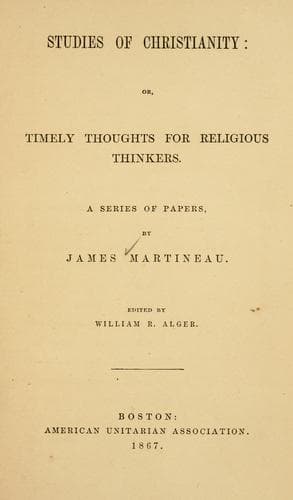
Studies of Christianity; Or, Timely Thoughts for Religious ThinkersMartineau, James
Religion
Studies of Christianity; Or, Timely Thoughts for Religious Thinkers
Martineau, James
Christianity; Church history -- 19th century
Human worship, therefore,
turning to the living God as the infant's eye to light, is itself a
witness to Him whom it feels after and adores; it is "the image and
shadow of heavenly things," the parallel chamber in our nature with
that Holy of Holies whither its incense ever ascends.
In a similar strain is this argument to show that
DEVOTION IS NOT A MISTAKE.
Be assured, all visible greatness of mind grows in looking at an
invisible that is greater. And since it is inconceivable that what is
most sublime in humanity should spring from vision of a thing that is
not, that what is most real and commanding with us should come of
stretching the soul into the unreal and empty, that historic
durability should be the gift of spectral fancies, we must hold these
devout natures to be at one with everlasting Fact,--to feel truly that
the august forms of Justice and Holiness are at home in heaven, the
object there of clearer insight and more perfect veneration. There are
those who please themselves with the idea that the world will outgrow
its habits of worship; that the newspaper will supersede the preacher
and prophet; that the apprehension of scientific laws will replace the
fervor of moral inspirations; that this sphere of being will then be
perfectly administered when no reference to another distracts
attention. But, for my own part, I am persuaded, that life would soon
become intolerable on earth, were it copied from nothing in the
heavens; that its deeper affections would pine away and its lights of
purest thought grow pale, if it lay shrouded in no Holy Spirit, but
only in the wilderness of space. The most sagacious secular voice
leaves, after all, a chord untouched in the human heart: listening too
long to its didactic monotone, we begin to sigh for the rich music of
hope and faith. The dry glare of noonday knowledge hurts the eye by
plying it for use and denying it beauty; and we long to be screened
behind a cloud or two of moisture and of mystery, that shall mellow
the glory and cool the air. Never can the world be less to us, than
when we make it all in all.
Our author makes a striking reply to the common assertion that
"THEOLOGY IS NOT A PROGRESSIVE SCIENCE."
Public-domain text, read in full here on John Shaqi.
Reviews
Reviews
No reviews yet
Be the first to share your thoughts on this work.
Join the Discussion
Join the discussion
Sign in to leave a comment or review.
Sign InorCreate an account