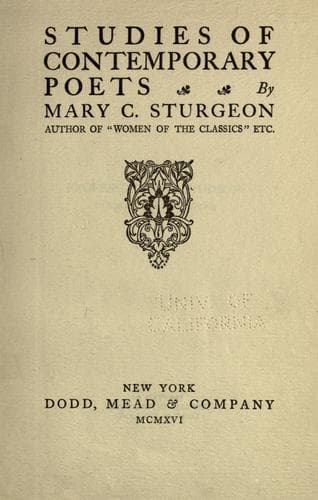
English poetry -- 20th century -- History and criticism
Another aspect of the same idea, caught in a more lyrical mood, will be
found in the poem called "The Trance." The poet is standing upon a
hill-side alone at night, watching the "continual stars" and overawed by
the vastness and "fixt law" of the universe. Then, in a sudden
revelation of perhaps a fraction of a minute:
I was exalted above surety
And out of time did fall.
As from a slander that did long distress,
A sudden justice vindicated me
From the customary wrong of Great and Small.
I stood outside the burning rims of place,
Outside that corner, consciousness.
Then was I not in the midst of thee
Lord God?
.....
That, however, is the triumphant ecstasy of a moment. More often he is
preoccupied with the duality in human nature, and in "An Escape" there
is a fine simile of the struggle:
Desire of infinite things, desire of finite.
... 'tis the wrestle of the twain makes man.
--As two young winds, schooled 'mong the slopes and caves
Of rival hills that each to other look
Across a sunken tarn, on a still day
Run forth from their sundered nurseries, and meet
In the middle air....
And when they close, their struggle is called Man,
Distressing with his strife and flurry the bland
Pool of existence, that lay quiet before
Holding the calm watch of Eternity.
The incidence of finite and infinite is felt with equal force: sense is
as powerful as spirit, and therein of course lives the keenness of the
strife. In "Soul and Body" there is a passage--only one of many,
however--in which the rapture of sensuous beauty is expressed. The
spirit is imagined to be just ready to put off sense, to be for ever
caught out of "that corner, consciousness." And the body reminds it:
Thou wilt miss the wonder I have made for thee
Of this dear world with my fashioning senses,
The blue, the fragrance, the singing, and the green.
.....
Great spaces of grassy land, and all the air
One quiet, the sun taking golden ease
Upon an afternoon:
Tall hills that stand in weather-blinded trances
As if they heard, drawn upward and held there,
Some god's eternal tune;
We may take our last illustration of this subject from a passage at the
end of the volume called _Emblems of Love_. It is from a poem so rich in
beauty and so closely wrought, that to quote from it is almost
inevitably to do the author an injustice. But the same may be said about
the whole book: while single poems from it will disclose high individual
value, both as art and philosophy, their whole effect and meaning can
only be completely seized by reading them as a sequence, and in the
light of the conception to which they all contribute.
Public-domain text, read in full here on John Shaqi.
Reviews
Reviews
No reviews yet
Be the first to share your thoughts on this work.
Join the Discussion
Join the discussion
Sign in to leave a comment or review.
Sign InorCreate an account