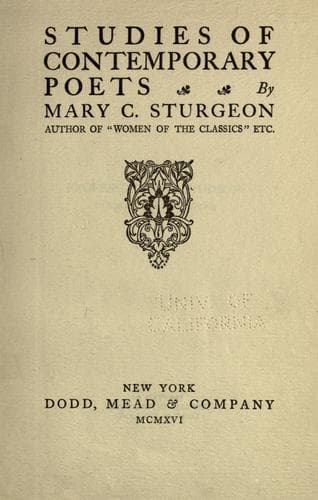
English poetry -- 20th century -- History and criticism
The book is designed to show, in three great movements representing
birth, growth, and perfection, the evolution of the human spirit in the
world. The spirit, which is here synonymous with love, is traced from
the instant which is chosen to mark its birth (the awakening sense of
beauty in primitive man), through its manifold states of excess and
defect, up to a transcendent union which draws the dual powers into a
single ecstasy. The greatness of the central theme is matched by the
dignity of its presentment, while the dramatic form in which it is
embodied saves it from mere abstraction. We see the dawn of the soul in
the wolf-hunter, suddenly perceiving beauty in nature and in women: the
vindication of the soul by Vashti, magnificently daring to prove that it
is no mere vassal to beauty: and the perfecting of the soul in the
terrible paradox of Judith's virginity. But it is in one of the closing
pieces, called fittingly "The Eternal Wedding," that the poet attains
the summit of his thought along these lines; prefiguring the ultimate
union of the conflicting powers of life in one perfect rapture.
... I have
Golden within me the whole fate of man:
That every flesh and soul belongs to one
Continual joyward ravishment ...
That life hath highest gone which hath most joy.
For like great wings forcefully smiting air
And driving it along in rushing rivers,
Desire of joy beats mightily pulsing forward
The world's one nature....
... so we are driven
Onward and upward in a wind of beauty,
Until man's race be wielded by its joy
Into some high incomparable day,
Where perfectly delight may know itself,--
No longer need a strife to know itself,
Only by its prevailing over pain.
That is the topmost peak that his philosophy has gained--for just so
long as to give assurance that it exists. But no one supposes that he
will dwell there: it is altogether too high: the atmosphere is too rare.
It was reached only by the concentration of certain poetical powers,
chiefly speculative imagination, which carried him safely over the
chasms of a lower altitude. But when other powers are in the ascendant,
as for instance in _The End of the World_: when he is recalled to
actuality by that keen eye for fact which is so rare a gift to genius of
this type, the terror of those lower chasms is revealed. Here is one of
the characters reflecting on the thought of the end of the world, which
he believes to be imminent from an approaching comet:
Public-domain text, read in full here on John Shaqi.
Reviews
Reviews
No reviews yet
Be the first to share your thoughts on this work.
Join the Discussion
Join the discussion
Sign in to leave a comment or review.
Sign InorCreate an account