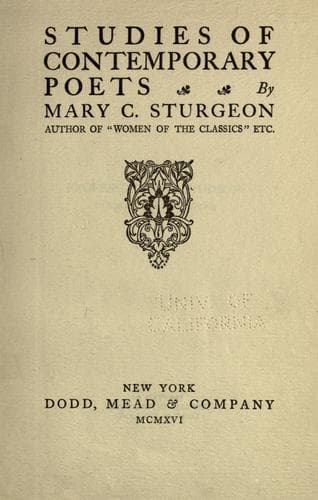
English poetry -- 20th century -- History and criticism
Reason might come back with the daylight to rule over fancy; and the
cool lapse of time might remove the moment far enough to betray the
humour of it. But the glow never quite faded; or if it did it only gave
place to the steadier and clearer light of conviction. One came to see
how the poet, by reason of his complete humanity, stood for mankind;
and how, from certain sharp characteristics of our race, he stood
pre-eminently for English folk. And coming thence to the narrower but
firmer ground of historical fact, one saw how shiningly he represented
the Elizabethan Age, with its eager, inquisitive, and adventurous
spirit; its craving to fulfil to the uttermost a gift of glorious and
abundant life.
Now precisely in that way, though not of course in the same superlative
degree, one may see Rupert Brooke standing for the England of his time.
And when this poet died at Lemnos on April 23, 1915, those who knew and
loved his work must have felt the tragic fitness of the date with the
event. If the gods of war had decreed his death, they had at least
granted that he might pass on England's day. In him indeed was
manifested the poetic spirit of the race, warm with human passion and
sane with laughter: soaring on wings of fire but nesting always on the
good earth. And though one does not claim to find in him the highest
point or the extremest advance to which the thought of his day had gone,
he stands pre-eminently for that day in the steel-clear light of his
gallant spirit.
The title of Rupert Brooke's posthumous book--_1914_--signifies that
moment of English history which is reflected in his work. He is the
symbol of that year in a double sense. He represents the calamitous
political event of it in his voluntary service to the State, and the
manner of his death. Thus by the accident of circumstance which made him
eminent and vocal, he serves to speak for the silent millions of English
men and women who splendidly sprang to duty. But in his poetry there is
a closer and deeper relation to that tragic year. Incomplete as it may
be: youthful and prankish as some of it is, the thought and manner of
the time are imaged there. A certain level of humane culture had been
reached, a certain philosophy of life had been evolved, and a definite
attitude to reality taken. Lightly but clearly, these things which
reflect the colour of our civilization at August 1914 are crystallized
in Rupert Brooke's poetry to that date. But at that point the image,
like the whole order of which it was the reflection, was shattered by
the crash of arms; and the few poems which he wrote subsequently are
preoccupied with the spiritual crisis which the war precipitated.
Public-domain text, read in full here on John Shaqi.
Reviews
Reviews
No reviews yet
Be the first to share your thoughts on this work.
Join the Discussion
Join the discussion
Sign in to leave a comment or review.
Sign InorCreate an account