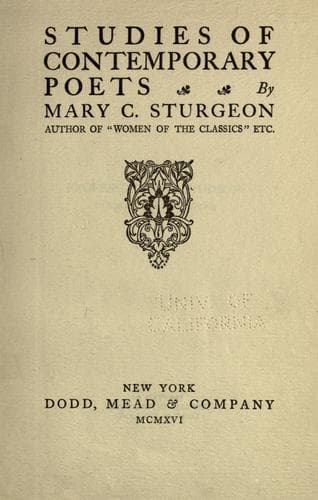
English poetry -- 20th century -- History and criticism
But, besides the range of the instrument, there is the exquisite harmony
of it with mood or idea. The strong down-beat of the trochee summons the
intellect to consider a thought: the dactyl will follow with the quick
perception of a simile: the iamb will punctuate rhythm: anacrusis will
suggest the half-caught breath of rising emotion, and turbulent feeling
will pour through spondee, dactyl, and anapæst. And so with the diction.
Just as we find a measure which is both vigorous and light, precise and
flexible, easily bending law to beauty; so in the language there is a
corresponding union of strength and grace, homeliness and dignity. Could
a great conception be stated in a simpler phrase than that of the two
first lines?
Life, the mother who lets her children play
So seriously busy, trade and craft--
and yet this phrase, simple and lucid as it is, conveys a sense of
boundless tenderness and pity, playing over the surface of a deeper
irony. Doubtless its strength and clarity come from the fact that each
word is of the common coin of daily life; but its atmosphere, an almost
infinite suggestiveness of familiar things brooded over in a wistful
mood, comes partly at least through the colloquial touch.
Mr. Abercrombie has no fear to be colloquial, when that is the proper
garment of his thought, the outer symbol of the inner reality. Nor is he
the least afraid of fierce and ugly words, when they are apt. The last
line of our passage illustrates this. Taken out of its setting, and
considering merely the words, one would count a poet rash indeed who
would venture such a harsh collocation. But repeat the line aloud, and
its metrical felicity will appear at once: put it back in its setting,
as the culmination of a wave of feeling that has been gathering strength
throughout: remember the idea (of beauty annihilated by senseless law
and blind force), which has kindled that emotion; and then we shall
marvel at the art which makes the line a growl of impotent rage.
All of which is merely to say that the spirit of this poetry has evolved
for itself a living body, wearing its beauty delightedly, rejoicing in
its own vitality, and unashamed either of its elemental impulse or its
transcendent vision.
Rupert Brooke
_Born at Rugby on August 3, 1887;
Died at Lemnos an April 23, 1915_
Probably most English people who love their country and their country's
greatest poet have at some time taken joy to identify the spirit of the
two. England and Shakespeare: the names have leapt together and flamed
into union before the eyes of many a youngster who was much too dazzled
by the glory to see how and whence it came. But returning from a
festival performance on some soft April midnight, or leaning out of the
bedroom window to share with the stars and the wind the exaltation which
the play had evoked, the revelation suddenly shone. And thenceforward
April 23 was by something more than a coincidence the day both of
Shakespeare and St George.
Public-domain text, read in full here on John Shaqi.
Reviews
Reviews
No reviews yet
Be the first to share your thoughts on this work.
Join the Discussion
Join the discussion
Sign in to leave a comment or review.
Sign InorCreate an account