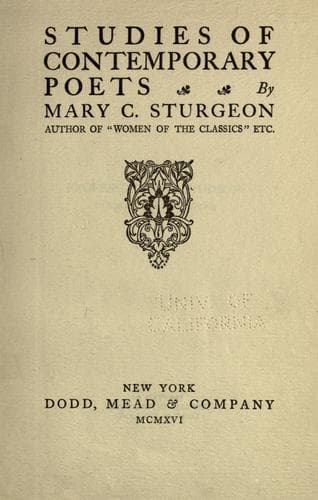
English poetry -- 20th century -- History and criticism
Occasionally, however, and especially in the longer poems, the regular
recurrence of the iamb is a little monotonous. Then a wish just peeps
out that Mr Davies were more venturous: that he had some slight
experimental turn, or that he did not stand quite so far aloof from the
influences which, within his sight and hearing, are shaping a new kind
of poetic expression. But the regret may be put aside. The fresh forms
which those others are evolving are valid for them--for life as they
conceive it--for the wider range and the more complex nature of the
experience out of which they are distilling the poetic essence. For him,
however, the lyric mood burns clear and untroubled, kindling directly to
the beauty of simple and common things. And instinctively he seeks to
embody it in cadence and measure which are sweetly familiar. When some
exhilarating touch quickens and lightens his verse with a more tripping
measure, as in "The Laughers" (from _Nature Poems_) its gay charm is
irresistible.
Mary and Maud have met at the door,
Oh, now for a din; I told you so:
They're laughing at once with sweet, round mouths,
Laughing for what? does anyone know?
Is it known to the bird in the cage,
That shrieketh for joy his high top notes,
After a silence so long and grave--
What started at once those two sweet throats?
Is it known to the Wind that takes
Advantage at once and comes right in?
Is it known to the cock in the yard,
That crows--the cause of that merry din?
Is it known to the babe that he shouts?
Is it known to the old, purring cat?
Is it known to the dog, that he barks
For joy--what Mary and Maud laugh at?
Is it known to themselves? It is not,
But beware of their great shining eyes;
For Mary and Maud will soon, I swear,
Find cause to make far merrier cries.
It is hard to close even a slight study of Mr Davies' work without
another glance at his originality. One hesitates to use that word,
strained and tortured as it often is to express a dozen different
meanings. It might be applied, in one sense or another, to nearly all
our contemporary poets, with whom it seems to be an article of artistic
faith to avoid like the plague any sign of being derivative. So,
although their minds may be steeped in older poetry, they deliberately
turn away from its influence, seeking inspiration in life itself. There
is no doubt that they are building up a new kind of poetry, with values
that sound strange perhaps to the unfamiliar ear, but which bid fair to
enlarge the field for the poetic genius and enrich it permanently. But
the crux of the question for us at this moment is the fact of effort,
the deliberate endeavour which is made by those poets to escape from
tradition. No sign of such an effort is visible in Mr Davies' work, and
yet it is the most original of them all--the newest, freshest, and most
spontaneous.
Public-domain text, read in full here on John Shaqi.
Reviews
Reviews
No reviews yet
Be the first to share your thoughts on this work.
Join the Discussion
Join the discussion
Sign in to leave a comment or review.
Sign InorCreate an account