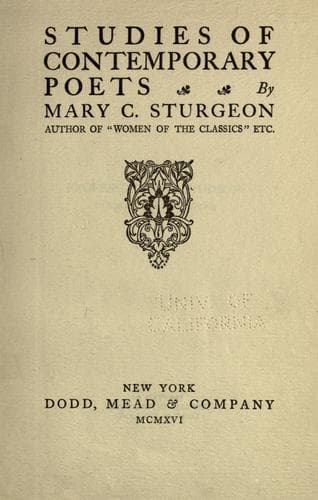
English poetry -- 20th century -- History and criticism
The reason lies, of course, in the qualities we have already noted. It
is not entirely an external matter, as the influence of his career might
lead us to believe. That has naturally played its part, making the
substance of some of his verse almost unique; and, more important still,
guarding him from bookishness and leaving his mind free to receive and
convey impressions at first hand. From this come the bracing freshness
of his poetry, its naïveté of language, its apparent artlessness and
unconscious charm. But the root of the matter lies deeper than that,
mainly I think in the sincerity and simplicity which are the chief
qualities of his genius. Both qualities are fundamental and constant,
vitalizing the work and having a visible influence upon its form. For,
on the one hand, we see that simplicity reflected not only in the
thought, and themes, but in the language and the technique of this
poetry; while on the other hand there is a loyalty which is absolutely
faithful to its own experience and the laws of its own nature.
_Walter De La Mare_
There is one sense in which this poet has never grown up, and we may, if
we please, recapture our own childhood as we wander with him through his
enchanted garden. And if it be true, as John Masefield says, that "the
days that make us happy make us wise," it is blessed wisdom that should
be ours at the end of our ramble. For see what a delightful place it is!
Not one of your opulent, gorgeous gardens, with insolently well-groomed
lawns and beds that teem with precious nurselings; but a much homelier
region, and one of more elusive and delicate charm. Boundaries there
are, for order and safe going, but they are hidden away in dancing
foliage: and there are leafy paths which seem to wind into infinity, and
corners where mystery lurks.
Some one is always sitting there,
In the little green orchard;
.....
When you are most alone,
All but the silence gone ...
Some one is waiting and watching there,
In the little green orchard.
Flowers grow in the sunny spaces, and all the wild things that children
love--primrose and pimpernel, darnel and thorn;
Teasle and tansy, meadowsweet,
Campion, toadflax, and rough hawksbit;
Brown bee orchis, and Peals of Bells;
Clover, burnet, and thyme....
Public-domain text, read in full here on John Shaqi.
Reviews
Reviews
No reviews yet
Be the first to share your thoughts on this work.
Join the Discussion
Join the discussion
Sign in to leave a comment or review.
Sign InorCreate an account