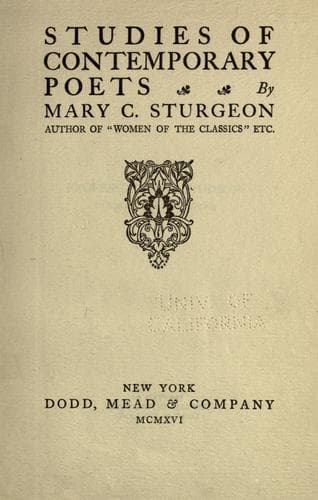
English poetry -- 20th century -- History and criticism
It is mostly a shadowy place however, not chill and gloomy, but arched
with slender trees, through whose thin leafage slant the warm fingers of
the sun, picking out clear, quickly-moving patterns upon the grass. The
air is soft, the light is as mellow as a harvest moon, and the sounds of
the outer world are subdued almost to silence. Nothing loud or strenuous
disturbs the tranquility: only the remote voices of happy children and
friendly beasts and kind old people. Wonder lives here, but not fear;
smiles but not laughter; tenderness but not passion. And the presiding
genius of the spot is the poet's "Sleeping Cupid," sitting in the shade
with his bare feet deep in the grass and the dew slowly gathering upon
his curls: a cool and lovesome elf, softly dreaming of beauty in a quiet
place.
So one might try to catch into tangible shape the spirit of this poetry,
only to realize the impossibility of doing anything of the kind. But
mere analysis would be equally futile; for the essence of it is as
subtle as air and as fluid as light; and one is finally compelled, in
the hope of conveying some impression of the nature of it, to fall back
upon comparison. It is a clumsy method however, frequently doing
violence to one or both of the poets compared; and even when used
discreetly, it often serves only to indicate a more or less obvious
point of resemblance. But we must take the risk of that for the moment,
and call out of memory the magical effect that is produced upon the mind
by the reading of "Kubla Khan," or "Christabel" or "The Ancient
Mariner." Very similar to that is the effect of Mr. de la Mare's poetry.
There is a difference, and its implications are important; but the chief
fact is that here, amongst this modern poetry of so different an order,
you find work which seems like a lovely survival from the age of
romance.
That is why one has the feeling that this poet has never grown up.
Partly from a natural inclination, and partly from a deliberate plan
(like that of Coleridge) to produce a certain kind of art, he has
created a faëry, twilight world, a world of wonder and fantasy, which is
the home of perpetual youth. He has never really lost that time when, as
a little boy, he says that he listened to Martha telling her stories in
the hazel glen. Martha, of 'the clear grey eyes' and the 'grave, small,
lovely head' is surely a veritable handmaid of romance:
'Once ... once upon a time ...'
Like a dream you dream in the night,
Fairies and gnomes stole out
In the leaf-green light.
And her beauty far away
Would fade, as her voice ran on,
Till hazel and summer sun
And all were gone:--
All fordone and forgot;
And like clouds in the height of the sky,
Our hearts stood still in the hush
Of an age gone by.
Public-domain text, read in full here on John Shaqi.
Reviews
Reviews
No reviews yet
Be the first to share your thoughts on this work.
Join the Discussion
Join the discussion
Sign in to leave a comment or review.
Sign InorCreate an account