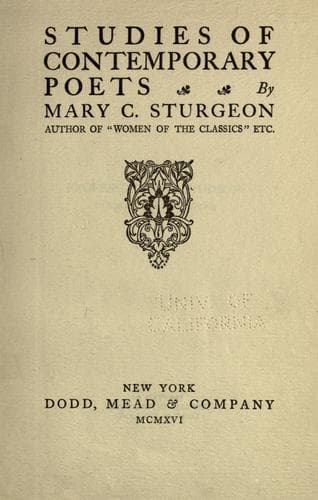
English poetry -- 20th century -- History and criticism
But that reminds us of the difference, and all that it implies. For,
after all, this poet is a romanticist of the twentieth century, and not
of the late eighteenth. It is true that his genius has surprisingly kept
its youth (even more, that is to say, than the poet usually does); but
it is a nonage which is clearly of this time and no other. The signs of
this are clear enough. First and foremost, there is his humanity--in
which perhaps all the others are included, and with which are certainly
associated the simplicity and sincerity of his diction. It is as though
the two famous principles on which the _Lyrical Ballads_ were planned
had in the fulness of time become united in the creative impulse of a
single mind. That is not to charge Mr de la Mare with the combined
weight of those two earlier giants, of course, but simply to observe the
truth which Rupert Brooke expressed so finely when he said that the
poetic spirit was coming back "to its wider home, the human heart." So
that even a born romanticist like this cannot escape; and into the
chilly enchantment of an older manner warm sunlight streams and fresh
airs blow.
Obvious links with the life-movement of his time are not lacking, though
as mere external evidence they are relatively unimportant. Of such are
the synthesis of poetry and science in "The Happy Encounter"; and the
detachment suggested in "Keep Innocency," where the poet reveals a full
consciousness of the gulf between romance and reality. But the influence
goes deeper than that. It is because he is a child of his age that he
has observed children so lovingly, and has wrought child-psychology into
his verse with such wonderful accuracy. That also is why he calls so
gently out of 'thin-strewn memory' such a homely figure as the shy old
maid in her old-fashioned parlour; and thence, too, comes the sympathy
with toiling folk--considering them characteristically in the serene
mood when their work is done--which underlies such pieces as "Old
Susan" and "Old Ben":
Sad is old Ben Thistlewaite,
Now his day is done,
And all his children
Far away are gone.
He sits beneath his jasmined porch,
His stick between his knees,
His eyes fixed vacant
On his moss-grown trees.
.....
But as in pale high autumn skies
The swallows float and play,
His restless thoughts pass to and fro,
But nowhere stay.
Soft, on the morrow, they are gone;
His garden then will be
Denser and shadier and greener,
Greener the moss-grown tree.
Public-domain text, read in full here on John Shaqi.
Reviews
Reviews
No reviews yet
Be the first to share your thoughts on this work.
Join the Discussion
Join the discussion
Sign in to leave a comment or review.
Sign InorCreate an account