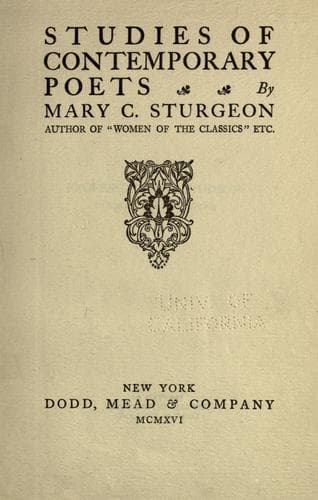
English poetry -- 20th century -- History and criticism
From the same humane temper come the poet's kindly feeling for animals
and his affectionate understanding of them. Over and over again its
positive aspect finds expression, either quaint, comical or tender. And
twice at least the negative side of it appears, coming as near to rage
at the wanton destruction of animal life as so mellow and balanced a
nature would ever get. It is a significant fact that at such moments he
takes refuge in his humour--that humour, at once rich and delicate,
which is perhaps the most precious quality of this poetry, and which,
growing from a free and sympathetic contact with life, holds the scale
counterpoised to a nicety against the glamorous romantic sense. Thus we
have this scrap of verse, lightly throwing off a mood of disgust in
whimsical idiom:
I can't abear a Butcher,
I can't abide his meat,
The ugliest shop of all is his,
The ugliest in the street;
Bakers' are warm, cobblers' dark,
Chemists' burn watery lights;
But oh, the sawdust butcher's shop,
That ugliest of sights!
And thus in "Tit for Tat" we find this apostrophe to a certain Tom
Noddy, just returning from a day of 'sport' with his gun over his
shoulder:
Wonder I very much do, Tom Noddy,
If ever, when you are a-roam,
An Ogre from space will stoop a lean face,
And lug you home:
Lug you home over his fence, Tom Noddy,
Of thorn-stocks nine yards high,
With your bent knees strung round his old iron gun
And your head dan-dangling by:
And hang you up stiff on a hook, Tom Noddy,
From a stone-cold pantry shelf,
Whence your eyes will glare in an empty stare,
Till you are cooked yourself!
The humour there, corresponding in degree to the indignation for which
it is a veil, is relatively broad. There are many subtler forms of it,
however, and one will be found in a charming piece which is apt to our
present point. It is called "Nicholas Nye," and tells about an old
donkey in an orchard. He is an unprepossessing creature, lame and
worn-out: just a bit of animal jettison, thrown away here to end his
days in peace. And the poet had a great friendship with him:
But a wonderful gumption was under his skin,
And a clear calm light in his eye,
And once in a while: he'd smile:--
Would Nicholas Nye.
Seem to be smiling at me, he would,
From his bush in the corner, of may,--
Bony and ownerless, widowed and worn,
Knobble-kneed, lonely and grey;
And over the grass would seem to pass
'Neath the deep dark blue of the sky,
Something much better than words between me
And Nicholas Nye.
_Wilfrid Wilson Gibson_
Public-domain text, read in full here on John Shaqi.
Reviews
Reviews
No reviews yet
Be the first to share your thoughts on this work.
Join the Discussion
Join the discussion
Sign in to leave a comment or review.
Sign InorCreate an account