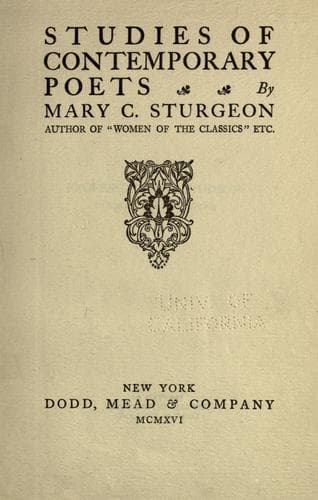
English poetry -- 20th century -- History and criticism
There are a dozen books by this author, the work of about a dozen years.
They began to appear in 1902; and they end, so far as the present survey
is concerned, with poems that were published in the first half of 1914.
They make a good pile, a considerable achievement in bulk alone; and
when they are read in sequence, they are found to represent a growing
period in the poet's mind and art which corresponds to, and epitomises,
the transition stage out of which English poetry is just passing. That
is to say, in addition to the growth that one would expect--the ripening
and development which would seem to be a normal process--there has
occurred an unexpected thing: a complete change of ideal, with steady
and rapid progress in the new direction. So that if Mr. Gibson's later
books were compared directly with the early ones, they might appear to
be by an entirely different hand. Place _Urlyn the Harper_--which was
first published--beside a late play called _Womenkind_ or a still more
recent dramatic piece called _Bloodybush Edge_; and the contrast will be
complete. On the one hand there is all the charm of romance, in material
and in manner--but very little else. On the other hand there is nothing
to which the word charm will strictly apply; an almost complete
artistic austerity: but a profound and powerful study of human nature.
On the one hand there is a dainty lyrical form appropriate to the theme:
there are songs like this one, about the hopeless love of the minstrel
for the young queen who is mated with an old harsh king:
I sang of lovers, and she praised my song,
The while the King looked on her with cold eyes,
And 'twixt them on the throne sat mailèd wrong.
I sang of Launcelot and Guenevere,
While in her face I saw old sorrows rise,
And throned between them cowered naked Fear.
I sang of Tristram and La Belle Isoud,
And how they fled the anger of King Mark
To live and love, deep sheltered in a wood.
Then bending low, she spake sad voiced and sweet,
The while grey terror crouched between them stark,
"Sing now of Aucassin and Nicolete."
The later work cannot be so readily illustrated: it is at once subtler
and stronger, and depends more upon the effect of the whole than upon
any single part. But for the sake of the contrast we may wrest a short
passage out of its setting in _Bloodybush Edge_. A couple of tramps have
met at night on the Scottish border; one is a cockney Londoner, a bad
lot with something sinister about him and a touch of mystery. He has
just stumbled out of the heather on to the road, cursing the darkness
and the loneliness of the moor. The other, a Border man to whom night is
beautiful and the wild landscape a familiar friend, protests that it is
not dark, that the sky is 'all alive with little stars':
Public-domain text, read in full here on John Shaqi.
Reviews
Reviews
No reviews yet
Be the first to share your thoughts on this work.
Join the Discussion
Join the discussion
Sign in to leave a comment or review.
Sign InorCreate an account