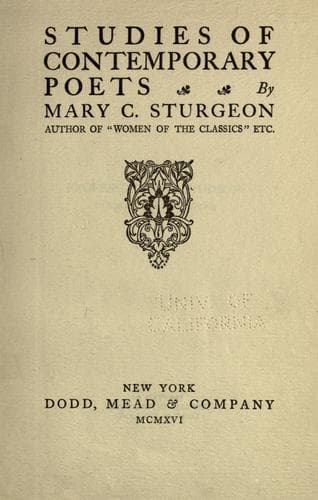
English poetry -- 20th century -- History and criticism
Money ... woman ... money!
I want naught with their money.
I want my husband,
And my children's father.
Let them pitch all their money in the furnace
Where he ...
I wouldn't touch a penny;
'Twould burn my fingers.
Money ...
For him!
There are fishermen in peril of the sea; the printer, the watchman, the
stonebreaker, the lighthousekeeper, the riveter, the sailor, the
shopkeeper; there are school-children and factory girls; outcasts,
tramps and gipsies; and a splendid company of women--mothers in
childbirth and child-death, sisters, wives and sweethearts--more heroic
in their obscure suffering and toil than the noblest figure of ancient
tragedy. With deliberate intention, therefore, the poet has set himself
to represent contemporary industrial life: the strata at the base of our
civilization. He has, as it were, won free at a leap from illusion, from
a dominant idealism, and the jealous, tyrannical instinct for mere
beauty. Life is the inspiration now, and truth the objective. The facts
of the workers' lives are carefully observed, realized in all their
significance and faithfully recorded. Sympathy and penetration go hand
in hand. Personal faults and follies, superstitions and vices, play
their part in these little dramas, no less than the social wrongs under
which the people labour. And the conception, in its balance and
comprehensiveness, is really great; for while on the one hand there is
an humiliating indictment of our civilization (implicit, of course, but
none the less complete) on the other hand there is a proud vindication
of the invincible human spirit.
Viewed steadily thus, by a poetic genius which has subdued the
conventions of its art, such themes are shown to possess a latent but
inalienable power to exalt the mind. They are therefore of the genuine
stuff of art, needing only the formative touch of the poet to evoke
beauty. And thus we find that although the normal process seems to have
been reversed here: although the poet has sought truth first--in event,
in character and in environment--beauty has been nevertheless attained;
and of a type more vital and complete than that evoked by the statelier
themes of tradition.
Public-domain text, read in full here on John Shaqi.
Reviews
Reviews
No reviews yet
Be the first to share your thoughts on this work.
Join the Discussion
Join the discussion
Sign in to leave a comment or review.
Sign InorCreate an account