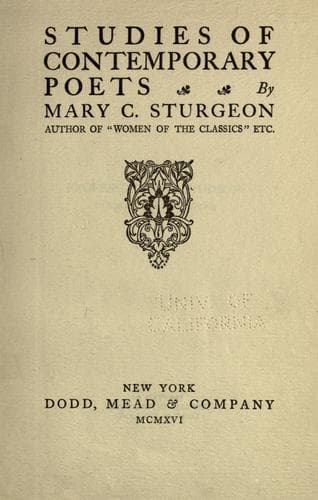
English poetry -- 20th century -- History and criticism
As might have been expected the new material and method have directly
influenced form; and hence arises another distinction of these later
works. The three parts of _Daily Bread_ and the play called _Womenkind_
are the extreme example; and their verse is probably unique in English
poetry. It has been evolved out of the actual substance on which the
poet is working; directly moulded by the nature of the life that he has
chosen to present. The poems here are dramatic; and whether the element
of dialogue or of narrative prevail, the language is always the living
idiom of the persons who are speaking. It is nervous, supple, incisive:
not, of course, with much variety or colour, since the vocabulary of
such people could not be large and its colour might often be too crude
for an artist's use. Selection has played its part, in words as in
incidents; but although anything in the nature of dialect has been
avoided, we are convinced as we read that this is indeed the speech of
labouring folk. We can even recognize, in a light touch such as an
occasional vocative, that they are the sturdy folk of the North country.
There is a dialogue called "On the Road" which illustrates that, as well
as more important things. Just under the surface of it lies the problem
of unemployment: a young couple forced to go on tramp, with their infant
child, because the husband has lost his job. That, however, inheres in
the episode: it is not emphasized, nor even formulated, as a problem.
The appeal of the poem is in its fine delineation of character, the
interplay of emotion, the rapid and telling dialogue--the pervasive
humanitarian spirit; and, once again, an exact and full perception of
the woman's point of view. Mr Gibson is a poet of his time in this as
well--in his large comprehension and generous acknowledgment of the
feminine part in the scheme of things. I do not quote to illustrate
that, because it is an almost constant factor in his work. But I give a
passage in which the Northern flavour is distinctly perceptible, in
addition to qualities which are limited to no locality--the kindliness
of the poor to each other and their native courtesy. An old stonebreaker
has just passed the starving couple by the roadside and, divining the
extremity they are at, he turns back to them:
Fine morning, mate and mistress!
Might you be looking for a job, my lad?
Well ... there's a heap of stones to break, down yonder.
I was just on my way ...
But I am old;
And, maybe, a bit idle;
And you look young,
And not afraid of work,
Or I'm an ill judge of a workman's hands.
And when the job's done, lad,
There'll be a shilling.
.....
Nay, but there's naught to thank me for.
I'm old;
And I've no wife and children,
And so, don't need the shilling.
.....
Public-domain text, read in full here on John Shaqi.
Reviews
Reviews
No reviews yet
Be the first to share your thoughts on this work.
Join the Discussion
Join the discussion
Sign in to leave a comment or review.
Sign InorCreate an account