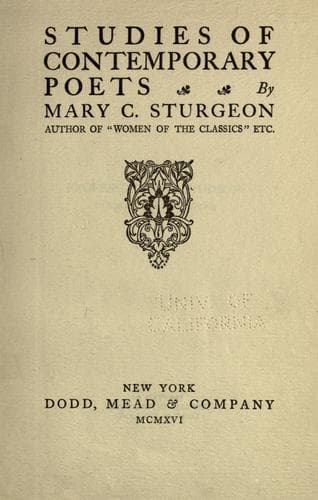
English poetry -- 20th century -- History and criticism
Mr Hodgson's work, then, will be found in four chapbooks and a thin
sheaf of broadsides. The chapbooks are small and slim, and could all be
picked up between the thumb and finger of one hand. They are wrapped in
cheery yellow and decorated with impressionistic sketches which, nine
times out of ten, perhaps, really help the illusion that the poet is
creating. The broadsides--there are about a dozen of them--are long
loose sheets, each containing a single poem similarly decorated.
The sum of the work is thus quite small. Perhaps there are not more than
five-and-twenty pieces altogether, none very long, and amongst them an
occasional miniature of a single stanza. Probably the format in which
the author has chosen to appear has had an effect in restricting his
production. That would be a possible result of the vigorous selection
exercised and the limits imposed in space and style. But there are signs
that he would not have been in any case a ready writer--the sense these
lyrics convey of having waited on inspiration until the veritable moment
shone, finding thought and feeling, imagination and technique, ripe to
express it. And by those very signs watchers knew and acclaimed this
author for a poet, despite the slender bulk of his accomplishment, long
before the Royal Society of Literature had awarded to his work the
_Polignac_ prize.
The two poems which gained the prize are "The Bull" and "The Song of
Honour." Each occupies a whole chapbook to itself, and therefore must be
accounted, for this poet, of considerable length. They are, indeed, the
most important of his poems. And if one does not immediately add that
they are also the most beautiful and the most charming, the reason is
something more than an aversion from dogma and the superlative mood.
For the artistic level of all this work is high, and it would be
difficult, on a critical method, to single out the finest piece. The
decision would be susceptible, even more than poetical judgments usually
are, to mood and individual bias. One person, inclining to the smaller,
gem-like forms of verse, will find pieces by Mr Hodgson to flatter his
fancy. This poet has, indeed, a gift of concentrated expression, before
which one is compelled to pause. There are tiny lyrics here which
comprise immensities. The facile imp that lurks round every corner for
the poor trader in words whispers 'epigram' as we read "Stupidity
Street" or "The Mystery" or "Reason has Moons." But is the specific
quality of these delicate creations really epigrammatic? No, it would
appear to be something more gracious and more subtly blent with emotion;
having implications that lead beyond the region of stark thought, and an
impulse far other than to sharpen a sting. "Stupidity Street" is an
example:
Public-domain text, read in full here on John Shaqi.
Reviews
Reviews
No reviews yet
Be the first to share your thoughts on this work.
Join the Discussion
Join the discussion
Sign in to leave a comment or review.
Sign InorCreate an account