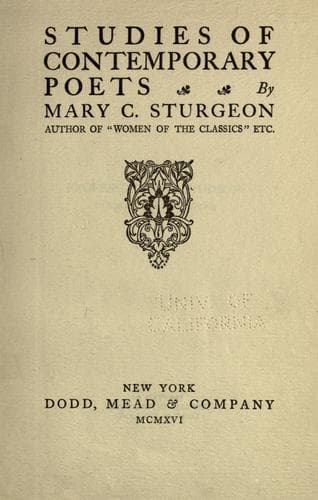
English poetry -- 20th century -- History and criticism
Now, since Synge has shown us that the poetry in the peasant heart does
utter itself spontaneously, in fitting language, we must be careful how
we deny, even to these peasants who are not Celts, a natural power of
poetic expression. But there is a difference. That spontaneous poetry of
simple folk which is caught for us in _The Playboy of the Western World
or The Well of the Saints_, is generally a lyric utterance springing
directly out of emotion. It is not, as here, the result of a mental
process, operating amongst ideas and based on knowledge which the
peasant is unlikely to possess. One may be justified, therefore, in a
show of protest at the incongruity; we feel that such people do not talk
like that. The poet has transferred to them too much of his own
intellectuality. Yet it will probably be a feeble protest, proportionate
to the degree that we are disturbed by it, which is practically not at
all. For as these people speak, we are convinced of their reality: they
live and move before us. And when we consider their complete and robust
individuality, it would appear that the poet's method is vindicated by
the dramatic force of the presentment. It needs no other vindication,
and is no doubt a reasoned process. For Mr Abercrombie makes no line of
separation between thought and emotion; and having entered by
imagination into the hearts of his people, he might claim to be merely
interpreting them--making conscious and vocal that which was already in
existence there, however obscurely. There is a hint of this at a point
in _The End of the World_ where one of the men says that he had _felt_ a
certain thought go through his mind--"though 'twas a thing of such a
flight I could not read its colour." And in this way Deborah, being a
human soul of full stature, sound of mind and body and all her being
flooded with emotion, would be capable of feeling the complex thought
attributed to her, even if no single strand of its texture had ever been
clear in her mind. While as to the fiddling lyrist, rogue and poet, one
sees no reason why the whole argument should not be closed by a gesture
in the direction of Heine or Villon.
We turn now to the content of thought in Mr Abercrombie's poetry--an
aspect of his genius to be approached with diffidence by a writer
conscious of limitations. For though we believed we saw that his
affinity with the democratic spirit of his age is instinctive, deeply
rooted and persistent, his genius is by no means ruled by instinct. It
is intellectual to an extreme degree, moving easily in abstract thought
and apparently trained in philosophic speculation. Indeed, his
speculative tendency had gone as far as appeared to be legitimate in
poetry, when he wisely chose another medium for it in the volume of
prose _Dialogues_ published in 1913.
Public-domain text, read in full here on John Shaqi.
Reviews
Reviews
No reviews yet
Be the first to share your thoughts on this work.
Join the Discussion
Join the discussion
Sign in to leave a comment or review.
Sign InorCreate an account