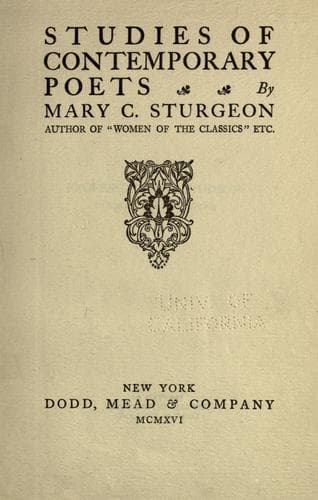
English poetry -- 20th century -- History and criticism
It must not be gathered from this, however, that the philosophic pieces
are dull or difficult reading. On the contrary, they are frequently cast
into the form of a story with a dramatic basis; and although the torrent
of thought sometimes keeps the mind astretch to follow it, it would be
hard to discover a single obscure line. An astonishing combination of
qualities has gone to produce this result: subtlety with vigour,
delicacy with strength, and loftiness with simplicity. Things elusive
and immaterial are caught and fixed in vivid imagery; and often charged
with poignant human interest. No other modern poet expresses thought so
abstract with such force, or describes the adventures of the voyaging
soul with such clarity. It suggests high harmony in the development of
sense and spirit: it explains the apparent incompatibility between his
rapture of delight in the physical world and his spiritual exaltation:
while it hints a reason for his preoccupation with the duality in human
life, and his vision of an ultimate union of the rival powers.
We may note in passing how this reacts upon the form of his work. It has
created a unique vocabulary (enriched from many sources but derived from
no single one), which is nervous, flexible, vigorous, impassioned:
assimilating to its grave beauty words homely, colloquial or quaint,
until the range of it seems all but infinite.
Again, rather curiously, the thought has tended toward the dramatic
form. At first glance that form would seem to be unsuitable for the
expression of reflectiveness so deep as this. Yet here is a poet whose
dominant theme might be defined, tritely, as the development of the
soul; and he hardly ever writes in any other way.
The fact sends us back to the contrast with the Victorians. The
representative poet then, musing about life and death and the evolution
of the soul, felt himself impelled to the elegiac form, or the idyll.
But the nature of the thought itself has changed. The representative
poet now does not stand and lament, however exquisitely, because reality
has shattered dogma: neither does he try to create an epic out of the
incredible theme of a perfect soul. He accepts reality; and then he
perceives that the perfect soul _is_ incredible, besides being poor
material for his art. But on the other hand, while he takes care to
seize and hold fast truth: while it does not occur to him to mourn that
she is implacable: he resolutely denies to phenomena, the appearance of
things, the whole of truth. That is to say, he has transcended at once
the despair of the Victorians and their materialism. He has banished
their lyric grief for a dead past, along with their scientific and
religious dogmas. That was a bit of iconoclasm imperatively demanded of
him by his own soul; but from the fact that he is a poet, it is denied
to him to find final satisfaction in the region of sense and
consciousness.
Public-domain text, read in full here on John Shaqi.
Reviews
Reviews
No reviews yet
Be the first to share your thoughts on this work.
Join the Discussion
Join the discussion
Sign in to leave a comment or review.
Sign InorCreate an account