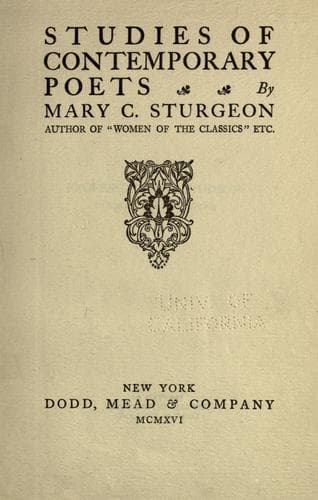
English poetry -- 20th century -- History and criticism
As I came down the valley after dark,
The little golden dagger at my breast
Flashed into fire lit by a sudden spark;
I saw the lights flame on the haunted hill,
My soul was blown about by a strange wind.
Though the green fir trees rose up stark and still
Against the sky, yet in my haunted mind
They bent and swayed before a magic storm:
A wave of darkness thundered through the sky,
And drowned the world....
In _Nera's Song_, again, as in the whole romance, we find the element
of dreams which is supposed to be an indubitable sign of the Celtic
temperament. Nera, who is the Queen's bard, has just returned after an
absence of one whole year in the Land of Faëry; and though it is autumn,
his arms are full of primroses, the fairies' magical flower:
I bring you all my dreams, O golden Maeve,
There are no dreams in all the world like these
The dreams of Spring, the golden fronds that wave
In faery land beneath dark forest-trees,--
I bring you all my dreams.
I bring you all my dreams, Fionavar,
From that dim land where every dream is sweet,
I have brought you a little shining star,
I strew my primroses beneath your feet,
I bring you all my dreams.
There is yet another style in which the heroic tales are occasionally
treated, and it is directly contrasted with either of those which we
have just considered. Examples of it may be found in Miss Alice
Milligan's book of _Hero Lays_, where it will be seen that the poet's
chief concern is with the story itself, rather than with the manner of
telling. In such a piece as "Brian of Banba," for instance, the action
is clear and moves rapidly. There is a sense of morning air and light in
the poem which is very refreshing after the atmosphere of golden
afternoon, or evening twilight, in which we have been wandering. It
comes partly from the blithe swing of the rhythm: partly from the vigour
and clear strength of diction. And a true dramatic sense imparts the
life and movement of quickly changing emotion.
Banba is one of the many beautiful old names for Ireland; and Brian was
perhaps her greatest king. He lived about the time of our English Alfred
and, like him, Brian fought continually against the invading Dane. He,
too, when a young man, lived for a long time the life of an
outlaw--outcast even from his own clan because he would not suffer the
Danish yoke. The poem relates an incident of Brian's appearance at the
palace of his brother, King Mahon, after a long absence. He strides into
the gay assembly alone, his body worn thin by privation and his garments
ragged.
"Brian, my brother," said the King, in a tone of scornful wonder,
"Why dost thou come in beggar-guise our palace portals under?
Where hast thou wandered since yester year, on what venture of love
hast thou tarried?
Tell us the count of thy prey of deer, and what cattleherds thou
hast harried."
.....
Public-domain text, read in full here on John Shaqi.
Reviews
Reviews
No reviews yet
Be the first to share your thoughts on this work.
Elsewhere in the archive
Join the Discussion
Join the discussion
Sign in to leave a comment or review.
Sign InorCreate an account