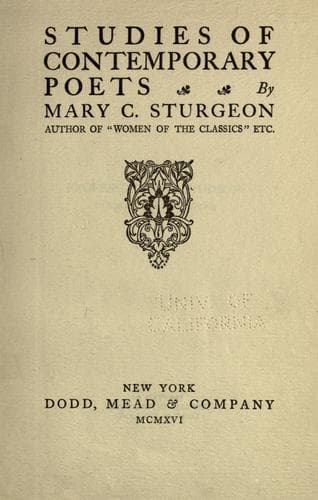
English poetry -- 20th century -- History and criticism
Thus there arises a duality, and a sense of conflict, which would
account for the manner of his expression, without the need to refer it
to the general tendency of modern poetry towards the dramatic form.
Doubtless, however, that also has been an influence, for the virility of
his genius and the positive strain in his philosophy would lead that
way.
One can hardly say that there are perceptible stages in Mr Abercrombie's
thought. He is one of the few poets with no crudities to repent, either
artistic or philosophic. Yet there is a poem in his first volume, a
morality called "The New God"; and there is another piece called "The
Sale of St Thomas," first published in 1911, which are relatively
simple. Here he is content to take material that is traditional, both to
poetry and religion, and infuse into it so much of modern significance
as it will carry. The first re-tells the mediæval legend of a girl
changed by God into his own likeness in order to save her from violence.
There is, apt to our present study, but too long to give in full, at
least one passage that is magnificent in conception and imagery alike.
It is the voice of God, answering the girl's prayer that she may be
saved by the destruction of her beauty. The voice declares that the
petition is sweet and shall be granted, that he will quit the business
of the universe, that he will "put off the nature of the world," and
become
God, when all the multitudinous flow
Of Being sets backward to Him; God, when He
Is only glory....
The "Sale of St Thomas" also treats a legend, with originality and
power. This remarkable poem is already well known: but one may at least
call attention to the fitness and dignity with which the poet has placed
the modern gospel upon the lips of the Christ. Thomas has been
intercepted by his master, as he is about to run away for the second
time from his mission to India.
Now, Thomas, know thy sin. It was not fear;
Easily may a man crouch down for fear,
And yet rise up on firmer knees, and face
The hailing storm of the world with graver courage.
But prudence, prudence is the deadly sin,
And one that groweth deep into a life,
With hardening roots that clutch about the breast.
For this refuses faith in the unknown powers
Within man's nature; shrewdly bringeth all
Their inspiration of strange eagerness
To a judgment bought by safe experience;
Narrows desire into the scope of thought.
But it is written in the heart of man,
Thou shalt no larger be than thy desire.
Thou must not therefore stoop thy spirit's sight
To pore only within the candle-gleam
Of conscious wit and reasonable brain;
.....
Public-domain text, read in full here on John Shaqi.
Reviews
Reviews
No reviews yet
Be the first to share your thoughts on this work.
Join the Discussion
Join the discussion
Sign in to leave a comment or review.
Sign InorCreate an account