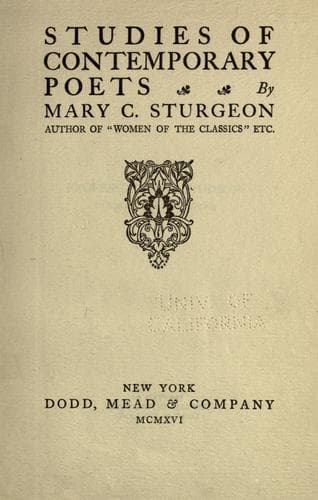
English poetry -- 20th century -- History and criticism
There are about half a dozen poets who are making these sweet, fresh
songs. They have not published very much, but that follows from the
nature of the medium in which they are working. Lyrical rapture is
brief, and the form of its expression correspondingly small. Very seldom
can it be sustained so long and so keenly as, for example, in Mr
Stephens' "Prelude and a Song," for the wise poet accepts the natural
limits of inspiration and technique. But this little group does not, of
course, include all the Irish lyrists. The poets whom we may describe as
literary--who have, at any rate, the more obvious connexion with the
revival--have made beautiful lyrics too. But they are sharply contrasted
in subject or style, or both, with those others. Thus we may take a
"Spring Rondel" by Mr Cousins, which is supposed to be sung by a
starling:
I clink my castanet,
And beat my little drum;
For spring at last has come,
And on my parapet
Of chestnut, gummy-wet,
Where bees begin to hum,
I clink my castanet,
And beat my little drum.
"Spring goes," you say, "suns set."
So be it! Why be glum?
Enough, the spring has come;
And without fear or fret
I clink my castanet,
And beat my little drum.
The lyrical virtues of that need no emphasis: the quick, true reflection
of a mood: the lightness of touch and grace of expression. It is,
however, mainly by qualities of form that one is delighted here--the
art's the thing. To make a rondel at all seems an achievement; and to
make it so daintily, with playful fancy and feeling caught to the nicest
shade, almost compels wonder. But that is characteristic of the kind of
verse of which I am speaking, another aspect of which may be seen in a
captivating fragment which has been translated by this poet from the
Irish of some period before the tenth century. It is called "The
Student"; and to find the like of it, with its combined love of nature
and of learning, one must seek a certain 'Clerk of Oxenford' and endow
him with the spirit of his own springtime poet--
High on my hedge of bush and tree
A blackbird sings his song to me,
And far above my linèd book
I hear the voice of wren and rook.
From the bush-top, in garb of grey,
The cuckoo calls the hours of day.
Right well do I--God send me good!--
Set down my thoughts within the wood.
It is not often that these poets are occupied with "Modern Movements,"
wherein they differ from their English contemporaries. For that reason,
it is the more significant that one public question has moved them
deeply. Thus we find Miss Mitchell writing of womanhood:
Oh, what to us your little slights and scorns,
You who dethrone us with a careless breath.
God made us awful queens of birth and death,
And set upon our brows His crown of thorns.
Public-domain text, read in full here on John Shaqi.
Reviews
Reviews
No reviews yet
Be the first to share your thoughts on this work.
Elsewhere in the archive
Join the Discussion
Join the discussion
Sign in to leave a comment or review.
Sign InorCreate an account