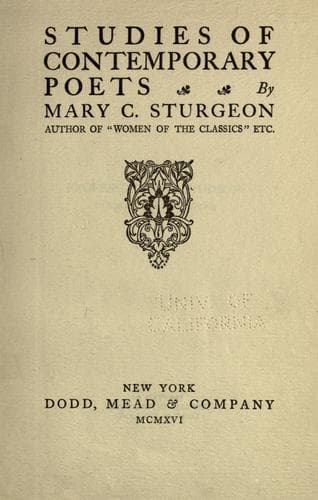
English poetry -- 20th century -- History and criticism
It is not, of course, a question of exact or direct comparison between,
let us say, the _Canterbury Tales_ and these narrative poems of the
twentieth century. It is rather a matter of the spirit of the whole
work, of the personality and its reaction to life, which satisfy one
individual at least of a resemblance. Of course it is not easily
susceptible of proof; but there are passages from the two poets which in
thought, feeling, and even manner of expression, will almost form a
parallel. Consider this stanza from a minor poem of Chaucer, a prayer
to the Virgin in the quaint form of an "A. B. C."
Xristus, thy sone, that in this world alighte,
Up-on the cros to suffre his passioun,
And eek, that Longius his herte pighte,
And made his herte blood to renne adoun;
And al was this for my salvacioun;
And I to him am fals and eek unkinde,
And yit he wol not my dampnacioun--
This thanke I you, socour of al mankinde.
The childlike faith of that, the quiet rapture of adoration, the abandon
and simple confidence, are curiously matched by the following passage
from "The Everlasting Mercy." Saul Kane has found his soul in the
mystical rebirth of Christianity, and dawn coming across the fields
lightens all his world with new significance.
O Christ who holds the open gate,
O Christ who drives the furrow straight,
O Christ, the plough, O Christ, the laughter
Of holy white birds flying after,
Lo, all my heart's field red and torn,
And Thou wilt bring the young green corn,
The young green corn divinely springing,
The young green corn for ever singing;
And when the field is fresh and fair
Thy blessèd feet shall glitter there.
And we will walk the weeded field,
And tell the golden harvest's yield,
The corn that makes the holy bread
By which the soul of man is fed,
The holy bread, the food unpriced,
Thy everlasting mercy, Christ.
So one might go on to contrast the several characteristics of this
poetry, and to trace them back to the combination of qualities in the
author's genius. This elemental religious emotion, dramatically fitted
as it is to the character, could only have found such expression by a
mind which deeply felt the primary human need of religion, and which was
relatively untroubled by abstract philosophy. But set over against that
is the almost pagan joy in the senses, the vigour and love of action
which make so strong a physical basis to this work; whilst, on the other
hand, there stands the astonishing contrast between the lyrical
intensity of the idyllic passages of these poems; and the dramatic power
(at once identified with humanity and detached from it) which has
created characters of ardent vitality.
Public-domain text, read in full here on John Shaqi.
Reviews
Reviews
No reviews yet
Be the first to share your thoughts on this work.
Elsewhere in the archive
Join the Discussion
Join the discussion
Sign in to leave a comment or review.
Sign InorCreate an account