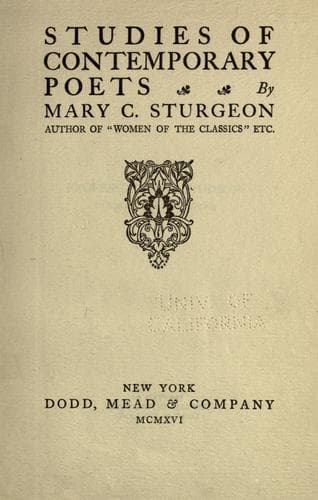
English poetry -- 20th century -- History and criticism
There is, of course, a corresponding technical contrast; but the fact
that it does 'correspond' is an answer to the critics who object to the
violence of certain scenes or to a literal rendering here and there of
thought or word. Granted that this poet is not much concerned to polish
or refine his verse, it remains true that the same sense of fitness
which closes three of these tragedies in exquisite serenity, governs
elsewhere an occasional crudity of expression or a touch of banality. It
is largely--though not always--a question of dramatic truth. The medium
is related to the material of this poetry and ruled by its moods. Hence
its realism is not an external or arbitrary thing. It is something more
than a trick of style or the adoption of a literary mode, being indeed a
living form evolved by the reality which the poet has designed to
express.
The root of the matter lies in a stanza of "Dauber." The young
artist-seaman, who is the protagonist here, has for long been patiently
toiling at his art at the prompting of instinct--the æsthetic impulse to
capture and make permanent the beauty of the material world. But the
pressure of reality upon him, the unimaginable hardships of a sailor's
existence, have threatened to crush his spirit. A crisis of physical
fear and depression has supervened; terror of the storms that the ship
must soon encounter, of the frightful peril of his work aloft, and of
the brutality of his shipmates, has shaken him to the soul. For a
moment, even his art is obscured, shrouded and almost lost in the whirl
of these overmastering realities. But when it emerges from the chaos it
brings revelation to the painter of its own inviolable relation with
those same realities.
... a thought occurred
Within the painter's brain like a bright bird:
That this, and so much like it, of man's toil,
Compassed by naked manhood in strange places,
Was all heroic, but outside the coil
Within which modern art gleams or grimaces;
That if he drew that line of sailors' faces
Sweating the sail, their passionate play and change,
It would be new, and wonderful, and strange.
That that was what his work meant; it would be
A training in new vision....
One might almost accept that as Mr Masefield's own confession of
artistic faith; it only needs the substitution of the word 'poet' for
the word 'painter' in the second line. But it is not quite complete as
it stands; and an important article of it will be discovered by reading
this poem through and noting the triumph of the ideal over the real,
which is the essential meaning of the work. It is not the most obvious
interpretation, perhaps. The idealist broken by the elements, wasted and
thrown aside, is hardly a victorious figure on the face of things. But,
in spite of that, the poem is a song of victory--of spirit over matter,
of the ideal over reality, of art over life.
Public-domain text, read in full here on John Shaqi.
Reviews
Reviews
No reviews yet
Be the first to share your thoughts on this work.
Elsewhere in the archive
Join the Discussion
Join the discussion
Sign in to leave a comment or review.
Sign InorCreate an account