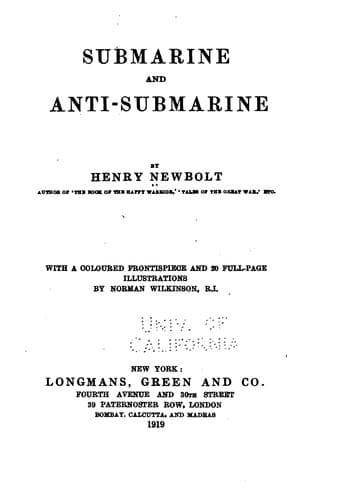
Submarine and Anti-submarineNewbolt, Henry John, Sir
History
Submarine and Anti-submarine
Newbolt, Henry John, Sir
Submarines (Ships); World War, 1914-1918 -- Naval operations -- Submarine
Three years later, in 1861, Olivier Riou designed two boats, in both of
which stability was to be preserved automatically by the device of a
double hull. The two cylinders which composed it, one within the other,
were not fixed immovably to one another, but were on rollers, so that
if the outer hull rolled to the right the inner rolled to the left.
By this counterbalancing effect, it was estimated that the stability
of the vessel would be absolutely secured; but nothing is recorded of
the trials of these boats. The celebrated French inventors, Bourgois
and Brun, reintroduced the principle of water-tanks combined with a
heavy iron ballast keel. But in 1881, the Rev. W. Garrett, the English
designer of the Nordenfelt boats, invented a new automatic mechanism
for ensuring stability. This consisted of two vertical rudders with
a heavy pendulum weight so attached to them that, if the boat dipped
out of the horizontal, the pendulum swung down and gave the rudders
an opposite slant which raised the vessel again to a horizontal
position. This arrangement, though perfect in theory, in practice
developed fatal defects, and subsequent types have all returned to the
use of water-tanks, made to compensate, by elaborate but trustworthy
mechanism, for every loss or addition of weight.
3. _Habitability._--For the habitability of a submarine the prime
necessity is a supply of air capable of supporting life during the
period of submersion. The first actual constructor of a submarine,
Cornelius van Drebbel, of Alkmaar, in Holland, was fully aware of
this problem, and claimed to have solved it, not by mechanical but by
chemical means. His improved boat, built in England about 1622, carried
twelve rowers, besides passengers, among whom King James I. is said to
have been included on one occasion, and was successfully navigated for
several hours at a depth of ten to fifteen feet. ‘Drebbel conceived,’
says Robert Boyle, in 1662, ‘that ’tis not the whole body of the air,
but a certain Quintessence (as Chymists speake) or spirituous part of
it that makes it fit for respiration, which being spent, the grosser
body or carcase (if I may so call it) of the Air, is unable to cherish
the vital flame residing in the heart: so that (for aught I could
gather) besides the Mechanical contrivance of his vessel he had a
Chymical liquor, which he accounted the chief secret of his Submarine
Navigation. For when from time to time, he perceived that the finer and
purer part of the Air was consumed or over-clogged by the respiration
and steames of those that went in his ship, he would, by unstopping a
vessel full of the liquor, speedily restore to the troubled air such a
proportion of vital parts as would make it again for a good while fit
for Respiration.’
Public-domain text, read in full here on John Shaqi.
Reviews
Reviews
No reviews yet
Be the first to share your thoughts on this work.
Join the Discussion
Join the discussion
Sign in to leave a comment or review.
Sign InorCreate an account