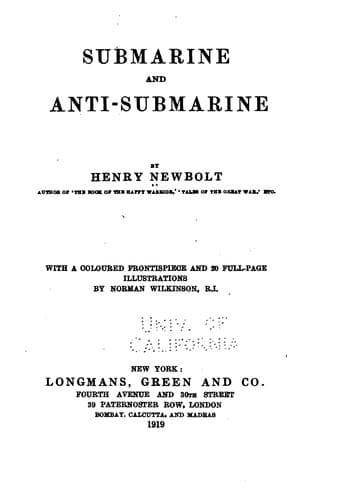
Submarine and Anti-submarineNewbolt, Henry John, Sir
History
Submarine and Anti-submarine
Newbolt, Henry John, Sir
Submarines (Ships); World War, 1914-1918 -- Naval operations -- Submarine
Drebbel, who was a really scientific man, may possibly have discovered
this chemical secret. If so, he anticipated by more than 200 years
a very important device now in use in all submarines, and in any
case he was the originator of the idea. But his son-in-law, a German
named Kuffler, who attempted after Drebbel’s death to exploit his
submarine inventions, was a man of inferior ability, and either
ignorant of the secret or incapable of utilising it. For another
century and a half, submarine designers contented themselves with the
small supply of air which was carried down at the time of submersion.
Even the _Turtle_--Bushnell’s boat of 1776, which has been described
as ‘the first submarine craft which really navigated under serious
conditions’--was only built to hold one man with a sufficient supply
of air for half an hour’s submersion. This was a bare minimum of
habitability, and Fulton, twenty-five years later, found it necessary
to equip his _Nautilus_ with a compressed air apparatus. Even with
this, the crew of two could only be supplied for one hour. In 1827,
the very able French designer, Castera, took out a patent for a
submarine life-boat, to which air was to be supplied by a tube from
the surface, protected by a float, from which the whole vessel was
suspended. The danger here was from the possible entry of water through
the funnel, and the boat, though planned with great ingenuity, was
never actually tried. Bauer, in 1855, fitted his _Diable Marin_ with
large water-tubes, running for thirty feet along the top of the boat
and pierced with small holes from which, when desired, a continual
rain could be made to fall. This shower-bath had a purifying effect on
the vitiated air, but it had obvious disadvantages; and there is no
record of its having been put into actual use before the unfortunate
vessel sank, as before related. In the same year, a better principle
was introduced by Babbage, an English inventor, who designed a naval
diving-bell, fitted with three cylinders of compressed air. His method
was followed by Bourgois and Brun, whose boats of 1863-5 carried
steel reservoirs with compressed air, at a pressure of at least 15
atmospheres. The principle was now established, and was adopted in
Holland and Lake boats, and in all subsequent types, with the addition
of chemical treatment of the vitiated air.
Public-domain text, read in full here on John Shaqi.
Reviews
Reviews
No reviews yet
Be the first to share your thoughts on this work.
Join the Discussion
Join the discussion
Sign in to leave a comment or review.
Sign InorCreate an account