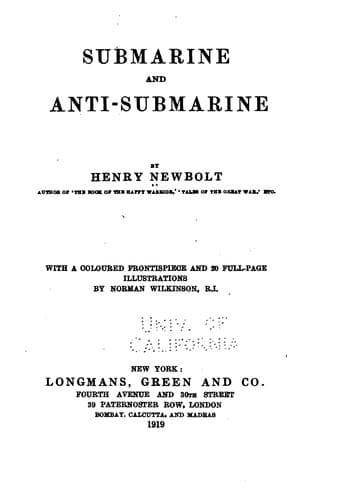
Submarine and Anti-submarineNewbolt, Henry John, Sir
History
Submarine and Anti-submarine
Newbolt, Henry John, Sir
Submarines (Ships); World War, 1914-1918 -- Naval operations -- Submarine
That the end of the pirate, when it does come, is terrible, may easily
be conjectured, but probably no imagination could give any idea of
the actual experience. There is, however, in existence a narrative,
compiled by a neutral from the evidence of two Germans who survived,
by an extraordinary chance, the destruction of their ship. These men
were among the crew of a U-boat of the largest and newest type, one of
the last to come out of Zeebrugge before the harbour was bottled up by
the _Intrepid_ and _Iphigenia_. She had not gone far from port when she
hit a mine and exploded it. The shock was severe, but did not at once
appear to be fatal. The electric switches were thrown out of position,
the lights in some compartments went out, and the vessel began to sink
rapidly by the stern; but the lighting did not take long to restore,
and the crew were immediately ordered to trim the boat by making a
combined rush forward. This manœuvre was successful in bringing her
to an even keel, but by no effort could she be induced to rise to the
surface.
Now began the terror; the plating of the ship had been shaken and
forced apart by the explosion; water was pouring in; the leaks were
rapidly enlarging, and all attempts to stop them failed. In very few
minutes the boat would be filled either with water or with chlorine
gas from the batteries. It was hardly possible to escape from the
death-trap; but there was one desperate chance, if the conning-tower
and forward hatches could be forced open against the pressure of the
sea.
The commanding officer and the chief engineer entered the conning-tower
and ordered their men to open one of the forward hatches. If this could
be done, though the crew would have little hope of pushing their way up
through the incoming torrent, the air-pressure inside the boat would
be so greatly increased that the officers would be probably enabled
to open the conning-tower and escape. But the outside pressure was
too great for the hatch to be moved. The most violent efforts were
made, the men working in relays and using their strength desperately,
while their companions urged them on with terrible cries. Meantime it
was becoming more and more difficult to breathe; the salt water was
penetrating the batteries and giving off chlorine gas. The stern of the
vessel was now fully flooded and the internal air pressure was rapidly
increasing as the free space grew less. The moment of suffocation was
near. But the hatch could not be raised.
Public-domain text, read in full here on John Shaqi.
Reviews
Reviews
No reviews yet
Be the first to share your thoughts on this work.
Elsewhere in the archive
Join the Discussion
Join the discussion
Sign in to leave a comment or review.
Sign InorCreate an account