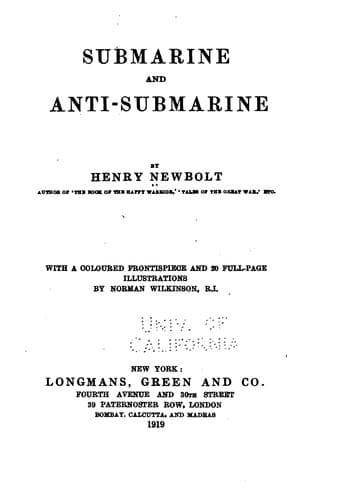
Submarine and Anti-submarineNewbolt, Henry John, Sir
History
Submarine and Anti-submarine
Newbolt, Henry John, Sir
Submarines (Ships); World War, 1914-1918 -- Naval operations -- Submarine
At this point, some of the crew lost control and behaved like madmen.
They crammed cotton waste into their ears and nostrils, and plunged
beneath the water, which was now knee-deep. One man turned his revolver
upon himself; it missed fire; he hurled it from him and plunged after
his comrades. One, who still kept his head, with a final effort forced
open one of the torpedo tubes and let in the water to end the struggle
one way or another. Hope returned for a moment. The internal air
pressure increased to such a pitch that the conning-tower and forward
hatch could both be opened. Officers and men sprang and fought their
way upwards through the inrush.
Perhaps twenty in all made their way out of the ship; but it was only
passing from one death to another. Human lungs are not adapted for
the sudden change from a deep-sea pressure to surface conditions. The
shrieks of these unfortunate men were heard by a trawler which happened
to be passing near; but before she could reach them all were dead but
two, and those two were broken men, bleeding from the lungs and crushed
in spirit. They had digged a cruel pit and fallen into the midst of it
themselves.
CHAPTER XVII
ZEEBRUGGE AND OSTEND
We have long been regretting that the work and the fame of our
Submarine Service are for the most part hushed to a kind of undertone.
We cannot speak of them as we wish, lest the enemy should overhear
and profit by information which he is unable to get for himself. But
there are victories that cannot be concealed--blows which must and
will reverberate, now and for ages to come. The work of the Navy at
Ostend and Zeebrugge may openly be spoken of as it deserves. And this
is fortunate; for nations, like men, ‘live by admiration, hope and
love,’ and admiration is not the least powerful of the three elements.
The double attack of St. George’s Day achieved not only a diminution of
the enemy’s strength, but an increase of our own. All over the world we
heard it hailed as a great feat of arms, and a proof of mastery; even
our own hearts were stronger for being so vividly reminded that our
seamen are what they have always been--the greatest fighting men alive.
The very conception of this attack was in itself conclusive evidence of
a high heroic spirit. The enterprise was not a wild-cat scheme, it was
both possible and useful, but it was one from which no man or officer
could expect to return. It was planned in November 1917, a month in
which the long and splendid work of our anti-submarine division was
rapidly advancing to success. The imagination of the Service rose with
the rising tide, and it was determined that the pirates should be not
only hunted down at sea, but harried and blocked in their principal
submarine sally-ports.
Public-domain text, read in full here on John Shaqi.
Reviews
Reviews
No reviews yet
Be the first to share your thoughts on this work.
Elsewhere in the archive
Join the Discussion
Join the discussion
Sign in to leave a comment or review.
Sign InorCreate an account