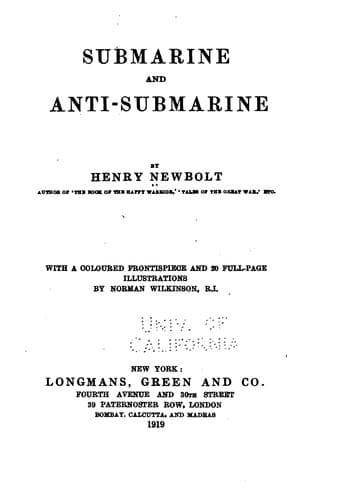
Submarine and Anti-submarineNewbolt, Henry John, Sir
History
Submarine and Anti-submarine
Newbolt, Henry John, Sir
Submarines (Ships); World War, 1914-1918 -- Naval operations -- Submarine
‘_I’ll Try’s_ shell struck the base of the conning-tower’ 185
‘The U-boat started with an enormous advantage of gun power’ 199
‘U.C.-boats stealing in across the black and silver water’ 211
‘The diver who first went down found the submarine lying on her
side’ 229
‘A fourth boat was partially lowered with a proper amount of
confusion’ 241
‘The U-boat never recovered from the surprise’ 245
‘Was steering about in figures of 8, with his gun still manned’ 265
‘A huge column of water which fell plump on the Commander’ 287
‘The submarine suddenly broke surface’ 291
‘A tremendous explosion was seen at the shore end of the Mole’ 305
SUBMARINE AND ANTI-SUBMARINE
CHAPTER I
THE SPIRIT OF SUBMARINE WAR
It is probable that a good deal of the information contained in this
book will be new to the public; for it has been collected under
favour of exceptional circumstances. But the reader will gain little
if he cannot contribute something on his side--if he cannot share
with the writer certain fundamental beliefs. The first of these is
that every nation has a spirit of its own--a spirit which is the
mainspring of national action. It is more than a mechanical spring;
for it not only supplies a motive force, but determines the moral
character of the action which results. When we read the history of
nations, and especially the history of their explorations, wars, and
revolutions, we soon recognise the spirit of each, and learn to expect
its appearance in every moment of crisis or endurance. If it duly
appears, our impression is confirmed; if it fails on any occasion, we
are disappointed. But the disappointments are few--nations may at times
surprise us; but, as a rule, they are like themselves. Even when they
develop and seem to change, they are apt, under the stress of action,
to return to their aboriginal character, and to exhibit it in their
old historic fashion. To attempt, then, to give an account of any
national struggle, without paying attention to the influence of the
characteristic spirit of the country or countries concerned, would be
a difficult undertaking, and a mistaken one. Even in a short crisis, a
great people will probably display its historic colours, and in a long
one it certainly will. To ignore this, to describe national actions
without giving a sense of the animating spirit, would be not only a
tame and inadequate method; it would lower the value of life itself by
making mere prose of what should, by right, partake of the nature of
poetry. History cannot often be entirely poetical, or poetry entirely
historical. When Homer told the tale of Troy, he did not make prose--or
even history--of it. He everywhere infused into it ‘an incomparable
ardour’--he made an epic. But Mr.
Public-domain text, read in full here on John Shaqi.
Reviews
Reviews
No reviews yet
Be the first to share your thoughts on this work.
Join the Discussion
Join the discussion
Sign in to leave a comment or review.
Sign InorCreate an account