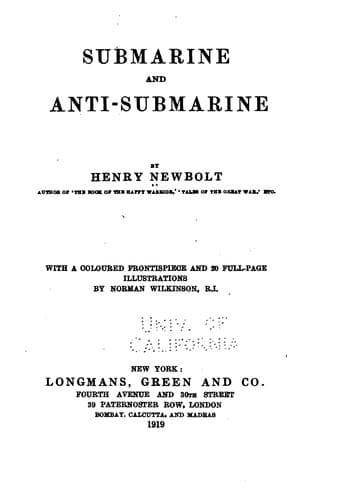
Submarine and Anti-submarineNewbolt, Henry John, Sir
History
Submarine and Anti-submarine
Newbolt, Henry John, Sir
Submarines (Ships); World War, 1914-1918 -- Naval operations -- Submarine
Thomas Hardy wrote history in ‘The
Dynasts,’ and made it an epic too. An epic--the common definition tells
us--is ‘a theme of action treated in heroic proportions and style.’
‘The Dynasts’ certainly is that--the struggle is great, the issues
are great, the men are great. Even more than their heroic fighting,
their speech and manners in the moment of action are such as to show
unfailingly by what a distinctive and ever-present spirit national life
may be sustained and magnified.
When we come to nearer times, and more familiar events, the same
necessity is upon us. What writer of artistic sense, or scientific
honesty, would touch, for example, the history of modern Egypt without
attempting to understand the character of such men as Gordon and
Cromer, and the spirit which (however personal and diverse in its
manifestations) they both drew from the nation that sent them forth?
Such an understanding would enable the narrator to carry us all with
him. For every man of our national birth and breeding would feel,
when he was told the story of such heroes, not only their superiority
but their likeness to himself. ‘There,’ he would say, ‘but for lack
of fortune, or opportunity, or courage, or stature, there goes John
Smith.’ It is admiration which helps us to feel that, and a mean spirit
which conceals it from us.
Further, it is my belief that the historian who would deal adequately
with our present War must have an even wider understanding and
sympathy. He must have a broad enough view to recognise all the various
motives which impelled us, section by section, to enter the struggle;
and a deep enough insight to perceive that, below all motives which can
be expressed or debated in words, there was an instinct--a spontaneous
emotion--which irresistibly stirred the majority of our people, and
made us a practically unanimous nation. He must be able to see that
this unanimity was no freak--no sudden outburst--but the natural
fulfilment of a strong and long-trained national character; and he must
trace, with grateful admiration, the national service contributed by
many diverse classes, and by a large number of distinguished men--the
leaders and patterns of the rest. However scientific the historian’s
judgments, and however restrained his style, it must be impossible for
any reader to miss the real point of the narrative--the greatness of
the free nations, and the nobility of their heroes. Belgians, Serbians,
French, Italians, Americans--all must hear their great men honoured,
and their corporate virtues generously recognised. We Britons, for our
own part, must feel, at every mention of the names of our champions,
the fine sting of the invisible fire with which true glory burns the
heart. It must never be possible to read, without an uplifting of the
spirit, the achievements of commanders like Smith-Dorrien, Haig, and
Birdwood--Plumer and Rawlinson, Allenby and Byng, and Horne; or the
fate of Cradock and Kitchener; or the sea-fights of Beatty and Sturdee,
Public-domain text, read in full here on John Shaqi.
Reviews
Reviews
No reviews yet
Be the first to share your thoughts on this work.
Join the Discussion
Join the discussion
Sign in to leave a comment or review.
Sign InorCreate an account