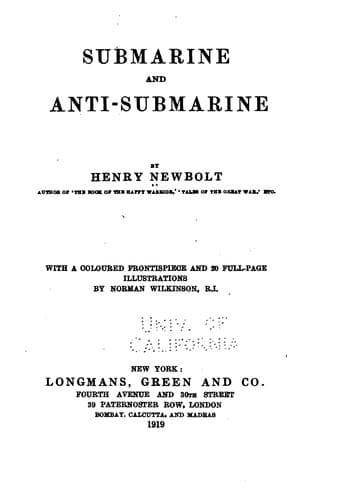
Submarine and Anti-submarineNewbolt, Henry John, Sir
History
Submarine and Anti-submarine
Newbolt, Henry John, Sir
Submarines (Ships); World War, 1914-1918 -- Naval operations -- Submarine
‘The Admiral writes outside, “Good look-out and prompt action of
_Swallow_ probably averted a casualty to the convoy.” He has to write
that most days--he must be tired of writing it.’
It is now two minutes to seven. As we drop into our picket-boat, the
destroyer slips silently from her moorings and fades away down stream
with eleven other thin grey phantoms.
CHAPTER V
SUBMARINES AND WAR POLICY
‘Strategy,’ says the ‘Encyclopædia Britannica,’ ‘has been curtly
described as the art of concentrating an effective fighting force at a
given place at a given time, and tactics as the art of using it when
there.’ In less scientific language, you fight a battle by means of
tactics, and a campaign by means of strategy. But when nations live, as
we have all been living for many years past, in constant preparation
for war, there must be forethought as to the means and methods to be
employed. Each nation has broad general plans, ready for the moment
when fighting is decided upon, and ships, guns, and armies are provided
accordingly. This is what is meant by war policy; and examples will
come to mind at once. We live in a group of islands, with Dominions
and other possessions overseas, and we have no desire to attack our
continental neighbours. British war policy has therefore always been
chiefly directed to the provision of an invincible navy for defending
our shores and our commerce. The German Empire, on the other hand,
is practically self-contained; it lies on the Continent, with land
powers for neighbours whom it has long hoped and intended to dominate.
German war policy, therefore, concerned itself until quite recently
with plans for aggression by land, and only provided a powerful fleet
when it became desirable to have a weapon in hand against England--not
necessarily to fight us on equal terms, but, as they said themselves,
to make us hesitate to take sides against them.
In this way it came about that both countries had a great naval war
policy, and watched each other carefully, building dreadnoughts
against dreadnoughts, and cruisers against cruisers. We made great and
successful efforts to keep the lead; for sea power is a matter of life
and death to us; and the Germans were spending every mark they could
spare, to get more and more nearly upon even terms. It is certain that
the war policy of both Powers took account of the possible uses of
submarine boats; but the lines of thought which they followed were in
some ways widely different, and they led, when war came, to unexpected
developments. Let us consider for a few moments what the British
admirals on the one hand, and the German on the other, intended to do
with their submarine forces, and what they actually did when the time
for action came.
Public-domain text, read in full here on John Shaqi.
Reviews
Reviews
No reviews yet
Be the first to share your thoughts on this work.
Join the Discussion
Join the discussion
Sign in to leave a comment or review.
Sign InorCreate an account