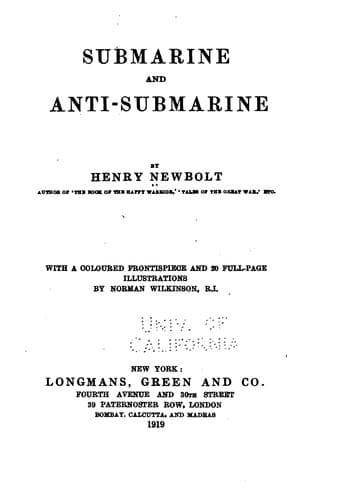
Submarine and Anti-submarineNewbolt, Henry John, Sir
History
Submarine and Anti-submarine
Newbolt, Henry John, Sir
Submarines (Ships); World War, 1914-1918 -- Naval operations -- Submarine
British war policy was essentially non-aggressive. The Navy had but one
possible antagonist of the first rank at sea, and that one we should
never have fought with, except in a war of defence. Our submarines,
therefore, had two obvious duties marked out for them. They would
help in coast defence by making it dangerous for ships of war or
transports to approach, and they might be used, if an opportunity
arose, to attack a fleet in harbour, or a cruiser at sea. There was
every probability that any fleet of a Power at war with us would
sooner or later have to spend a good deal of time in port, and it
would certainly be well to have the means to attack it there. But,
important as this function was, the idea of defence against invasion
probably came first, and there is no doubt that an efficient submarine
force is a very formidable addition to our flotilla for coast defence.
Perhaps we thought, in those years of perpetual preparation, too much
about the ‘Invasion of England’ and too little about the duty of
supporting our Allies on land; and we had this much justification,
that the Power from which we had every reason to expect an attack,
was one directed by men of great energy and determination, certain to
be relentless in pressing a war home upon us, even at the risk of a
heavy loss. On the other hand, those who spoke and wrote most about
invasion, nearly always failed to realise the immense difficulty of
the undertaking; and they failed especially to see that, in modern
times, the conditions had changed very considerably in favour of the
defence. The initial problem of an invader by sea must always be the
provision of transport sufficient for a large body of troops, with
arms, equipment, and supplies of food and munitions. Even if we allow
only two tons of shipping per man--the Japanese allowed six tons--the
transport of 100,000 men would take twenty vessels of 10,000 tons each,
and to collect these and load them would be a big operation; difficult
to conceal. In fact to conceal it, for a sufficiently long time, from
a defence force well supplied with wireless telegraphy, fast scouts,
and aerial observation, would now be a practical impossibility. But
even if we suppose such an expedition to be able (under cover of fog,
or by a complete surprise) to cross the North Sea unobserved, there
remains the further difficulty of the landing. A place must be found
where the invaders could obtain immediate control of supplies and
communications; there are but half a dozen such places at most upon our
eastern coast-line, and these are all prepared for a strenuous defence
by land. If we add to the land defence a mine-field and the presence of
an unknown number of submarines, the attempt becomes one involving the
certainty of immense losses, and the extreme probability of failure.
Even the German war-lords have not yet made up their minds to the risk
of seeing eight or ten divisions drowned in an hour.
Public-domain text, read in full here on John Shaqi.
Reviews
Reviews
No reviews yet
Be the first to share your thoughts on this work.
Join the Discussion
Join the discussion
Sign in to leave a comment or review.
Sign InorCreate an account