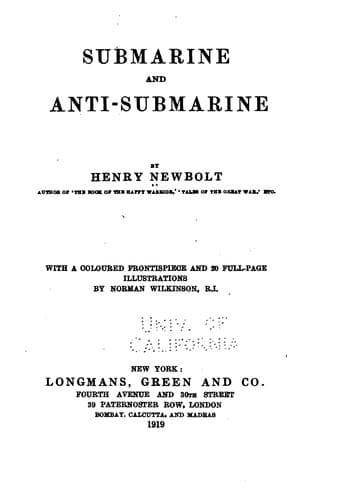
Submarine and Anti-submarineNewbolt, Henry John, Sir
History
Submarine and Anti-submarine
Newbolt, Henry John, Sir
Submarines (Ships); World War, 1914-1918 -- Naval operations -- Submarine
Let us take a single virtue, like courage, which is common to all
nations but shows under a different form or colour in each, and
so becomes a national characteristic, plainly visible in action.
A historical study of British courage would, I believe, show two
facts: first, that the peculiar quality of it has persisted for
centuries; and, secondly, that if our people have changed at all in
this respect, they have only changed in the direction of greater
uniformity. Once they had two kinds of courage in war; now they have
but one, and that by far the better one. In the old days, among the
cool and determined captains of our race, there were always a certain
number of hot heads--‘men of courage without discipline, of enthusiasm
without reason, of will without science.’ The best of them, like Sir
Richard Grenville, had the luck to die conspicuously, in their great
moments, and so to leave us an example of the spirit that defies odds,
and sets men above the fear of death. The rest led their men into
mad adventures, where they perished to the injury of their cause.
Most Englishmen can understand the pure joy of onset, the freedom of
the moment when everything has been given for the hope of winning
one objective; but it has been the more characteristic way of our
people--at any rate for the last five centuries--to double courage
with coolness, and fight not only their hardest but their best. From
Cressy to Waterloo, and from Mons to Arras, we have won many battles
by standing steadily and shooting the attack to pieces. Charges our
men have made, but under discipline and in the nick of opportunity.
The Black Prince charged fiercely at Poitiers; but it was only when he
had broken three attacks, and saw his chance to win. The charge of the
Worcesters at Gheluvelt, the charge of the Oxfords at Nonneboschen, and
a hundred more like them, were as desperate as any ‘ride of death’; but
they were neither reckless nor useless, they were simply the heroic
move to win the game. Still more is this the rule at sea. Beatty at
Jutland, like Nelson and Collingwood at Trafalgar, played an opening in
which he personally risked annihilation; but nothing was ever done with
greater coolness, or more admirable science. The perfect picture of all
courage is, perhaps, a great British war-ship in action; for there you
have, among a thousand men, one spirit of elation, of fearlessness, of
determination, backed by trained skill and a self-forgetful desire to
apply it in the critical moment. The submarine, and the anti-submarine
ship, trawler or patrol-boat are, on a smaller scale, equally perfect
examples; for there is no hour of their cruise when they are not within
call of the critical moment. In the trenches, in the air, in the fleet,
you will see the same steady skilful British courage almost universally
exemplified. But in the submarine war, the discipline needed is even
more absolute, the skill even more delicate, the ardour even more
Public-domain text, read in full here on John Shaqi.
Reviews
Reviews
No reviews yet
Be the first to share your thoughts on this work.
Join the Discussion
Join the discussion
Sign in to leave a comment or review.
Sign InorCreate an account