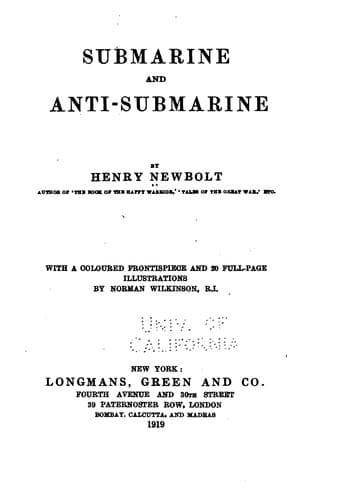
Submarine and Anti-submarineNewbolt, Henry John, Sir
History
Submarine and Anti-submarine
Newbolt, Henry John, Sir
Submarines (Ships); World War, 1914-1918 -- Naval operations -- Submarine
continuous and self-forgetful; and all these demands are even more
completely fulfilled.
This is fortunate, and doubly fortunate; for the submarine war has
proved to be the main battlefield of our spiritual crusade, as well
as a vital military campaign. The men engaged in it have been marked
out by fate, as our champions in the contest of ideals. They are the
patterns and defenders of human nature in war, against those who
preach and practise barbarism. Here--and nowhere else so clearly as
here--the world has seen the death struggle between the two spirits
now contending for the future of mankind. Between the old chivalry,
and the new savagery, there can be no more truce; one of the two must
go under, and the barbarians knew it when they cried _Weltmacht oder
Niedergang_. Of the spirit of the German nation it is not necessary
to say much. Everything that could be charged against them has been
already proved, by their own words and actions. They have sunk without
warning women and children, doctors and nurses, neutrals and wounded
men, not by tens or hundreds but by thousands. They have publicly
rejoiced over these murders with medals and flags, with songs and
school holidays. They have not only broken the rules of international
law; they have with unparalleled cruelty, after sinking even neutral
ships, shot and drowned the crews in open boats, that they might
leave no trace of their crimes. The men who have done--and are still
doing--these things have courage of a kind. They face danger and
hardship to a certain point, though, by their own account, in the last
extreme they fail to show the dignity and sanity with which our own
men meet death. But their peculiar defect is not one of nerve, but
of spirit. They lack that instinct which, with all civilised races,
intervenes, even in the most violent moment of conflict or desperation,
and reminds the combatant that there are blows which it is not lawful
to strike in any circumstances whatever. This instinct--the religion
of all chivalrous peoples--is connected by some with humanity, by some
with courtesy, by ourselves with sport. In this matter we are all in
the right. The savage in conflict thinks of nothing but his own violent
will; the civilised and the chivalrous are always conscious of the fact
that there are other rights in the world beside their own. The humane
man forbears his enemy; the courteous man respects him, as one with
rights like his own; the man with the instinct of sport knows that
he must not snatch success by destroying the very game itself. The
civilised nation will not hack its way to victory through the ruins
of human life. It will be restrained, if by no other consideration,
yet at least by the recollection that it is but one member of a human
fellowship, and that the greatness of a part can never be achieved by
the corruption of the whole.
Public-domain text, read in full here on John Shaqi.
Reviews
Reviews
No reviews yet
Be the first to share your thoughts on this work.
Join the Discussion
Join the discussion
Sign in to leave a comment or review.
Sign InorCreate an account