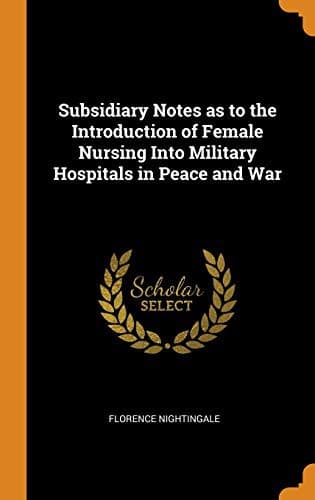
Subsidiary Notes as to the Introduction of Female Nursing into Military Hospitals in Peace and WarNightingale, Florence
History
Subsidiary Notes as to the Introduction of Female Nursing into Military Hospitals in Peace and War
Nightingale, Florence
Military hospitals -- Great Britain; Nurses -- Great Britain
15. I think the head-nurses should wear a regulation dress, and the
nurses another; if we adopt the honest word livery, in use in the
hospitals, it will perhaps do no harm. Caps, dresses, aprons, should
be prescribed: whether or not out-of-door dress should be prescribed
is to be considered apart. Each should have three dresses yearly.
Better, I think, avoid washing stuffs; they require endless change to
look decent. Head-nurses and nurses might wear the same dress, and some
difference in the cap would be quite distinction enough.
[Sidenote: Wages.]
16. I incline towards giving the head-nurses £50 a-year, one or two
rooms (one room with an alcove and curtain would be best), fuel and
light. The nurses lodging; the night-nurse a room to herself, the
others together; entire board, fuel, light, and good wages to be
decided upon.
[Sidenote: Furniture.]
17. The nurses’ rooms should be supplied with plain comfortable
furniture. In the large Hospitals the head-nurse furnishes her own
room or rooms, which doubtless promotes her comfort and her care of
the furniture, both desirable things; yet the tendency of many to
accumulate decorations, which take time to clean, &c., is a drawback.
I should be inclined, as an experiment, to try the furnishing plan, or
at least to have some scale as to furniture allowed. A bed, arm-chair,
and sofa; a chest of drawers, wash-hand table or shelf; book-case
or shelves; a little table, and a larger one, a couple of chairs, a
footstool, and a cupboard with broad shelves, are the utmost that can
be required.
[Sidenote: Visitors.]
18. A difficult and important point to settle is the amount of liberty
allowed as to receiving visits. It is desirable on all accounts to make
head-nurses and nurses feel comfortable, and, as it were, at home:
it is also better they should not be unnecessarily out; also London
distances are great, and even omnibus-fare is a consideration; also
it is important to remember that these women are apt to feel and say:
“We are not in a nunnery,” nor should they be. Still upon the whole,
considering the nuisance of ordinary visitors, and the greater nuisance
of extraordinary (_e. g._, visitors to some head-nurses, kind friends
come to see how we are getting on, &c., &c., &c.), I think if it were
possible to make the rule that no visitors are allowed, it would be
a great gain. I am not sure, at present, whether it is possible or
not--still less whether it is possible to keep such a rule, if made.
But, at all events, nurses and head-nurses should only be permitted
to receive visitors on certain days and hours of the week; and those
hours and days should be strictly kept to. In Military Hospitals a
still more rigid rule will be necessary.
[Sidenote: Discharged Patients.]
19. No discharged patients, however previously well-conducted, should
be allowed to visit the wards.
[Sidenote: Graduated scale of Pensions.]
Public-domain text, read in full here on John Shaqi.
Reviews
Reviews
No reviews yet
Be the first to share your thoughts on this work.
Join the Discussion
Join the discussion
Sign in to leave a comment or review.
Sign InorCreate an account