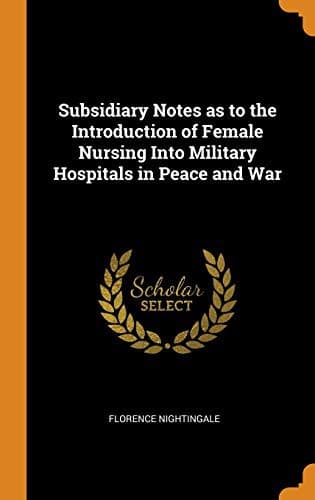
Subsidiary Notes as to the Introduction of Female Nursing into Military Hospitals in Peace and WarNightingale, Florence
History
Subsidiary Notes as to the Introduction of Female Nursing into Military Hospitals in Peace and War
Nightingale, Florence
Military hospitals -- Great Britain; Nurses -- Great Britain
20. Apart from raising the wages of good nurses after every ten years’
service, I think it would well answer to establish a graduated scale
of pensions, for both head-nurses and nurses; beginning with a small
pension after ten years’ good service, increasing every five years
afterwards. Many women are quickly worn out in this life; and it is
equally undesirable to turn faithful worn-out servants adrift without
any provision, or to retain them in duties for which they are become
unfit. It is a question whether there should not be a compulsory
stoppage from wages, in order to entitle the nurses to pension under
conditions.
[Sidenote: No occasional Wards.]
21. Have no occasional wards, or wards for accidental and peculiar
patients.
[Sidenote: Head-Nurse to each Ward.]
22. Every ward, or set of wards, should be under a head-nurse.
Discipline is always defective under other arrangements.
[Sidenote: Religious Influence.]
23. This turns greatly upon a previous question. Every endeavour should
be used to bring the women under the influence of religion, God’s
instrument for saving, strengthening, and comforting souls. So far as
this work depends on rule, system, and superintendence, great things
may be done at any rate--so far as moral influence is concerned, it
can only be hoped for in the channels appointed by Him who turneth all
hearts whithersoever He will.
III. NURSES IN HER MAJESTY’S HOSPITALS.
[Sidenote: Two kinds of Hospital Service for Females.]
1. If their introduction is eventually commanded by the Queen’s
Government, it will be advisable to consider that their service admits
of two distinct kinds.
[Sidenote: The one: its Advantages;]
2. “Their chief duties” may be “taking charge of the linen and
superintending the issue of extras.”
They will thus contribute materially to the comfort and well-being
of the sick; the real difficulties which undoubtedly beset the
introduction of women into ward service will be avoided; and, an
important consideration, not lightly to be discarded, their exclusion
from the ward service will materially diminish the opposition of
adverse masters, some of whom are also unscrupulous masters.
[Sidenote: The other: its Advantages.]
3. On the other hand, I suppose, the experience of every woman,
admitted to ward service in hospitals where women were not before,
is that many lives are actually saved by such admission, which would
otherwise, humanly speaking, be lost. In time of war some ciphers may
be safely added to the many. Any other great emergency, I suppose, but
do not speak from experience, would give the same result.
That the experience of many surgeons is identical, their conduct has
proved; no other testimony, under present circumstances, can rationally
be expected from them.
[Sidenote: Both to be Weighed.]
4. It is often right to begin with the smaller and less-opposed good,
and to introduce gradually, and, as it pleases God, the remainder. It
may be our duty to do this, as to this matter.
Public-domain text, read in full here on John Shaqi.
Reviews
Reviews
No reviews yet
Be the first to share your thoughts on this work.
Join the Discussion
Join the discussion
Sign in to leave a comment or review.
Sign InorCreate an account