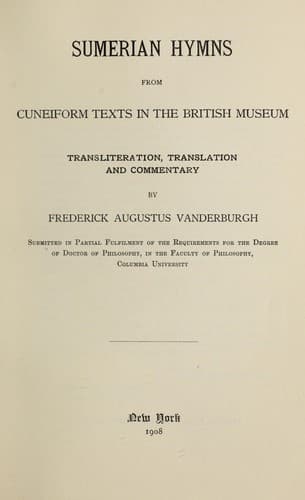
Sumerian Hymns from Cuneiform Texts in the British Museum
Religion
Sumerian Hymns from Cuneiform Texts in the British Museum
Hymns, Sumerian; Sumerian language -- Texts
This Ašurbânipal hymn may be considered as remarkable for its advanced
ideas. In the first part of the hymn there is introduced the
mythological idea of the bullock’s head in the moon with horns and the
face with flowing hazel-colored beard, so that strength and brilliancy
are pointed out. But the hymn advances into literal speech by which the
most varied and greatest of divine attributes are attached to the god
Nannar. He is named as sovereign god, a self-created god, a merciful
god, the begetter of all life, the maintainer of the life of the world,
the bestower of gifts to men, the establisher of dwellings; he fixes
destinies, pronounces judgment, gives water to man and supplies him with
vegetable food. He holds a unique and exalted position in heaven and on
earth above all other beings. To him the angels of heaven and spirits of
earth bow, and at his command the forces of nature perform their
marvellous functions.
3. _Adad_
The storm-god is known by the Sumerian ideogram _Im_. The sign IMMU in
the El-Amarna tablets (1500 B. C.) has the reading Adad, a name
connected with the Syrian Hadad. Oppert thinks Adad is the god’s oldest
name. It seems evidently a foreign equivalent for _Im_. The Assyrian
name Ramman is a provisional name meaning “thunderer”, and probably only
an epithet. The sign IMMU has also the value _Mer_. This is, no doubt,
the original and real name of the god, which appears as well in the form
Immer. The primary idea in the name is that of wind, then, that of rain
and finally of thunder and lightning. The god is not an object like
Nannar, but a force; then the force is personified and he is spoken of
as a person. Ḥammurabi puts him in the second triad of gods. He is the
third person of that triad, Sin being the first person and Šamaš the
second. Generally Ištar has the third place in the second triad. In that
case Ramman falls outside of that triad and takes position among all the
gods as seventh in importance. The order is as follows: Anu, Bêl, Ea,
Sin, Šamaš, Ištar, Adad (Ramman). As a Babylonian god we find Ramman’s
name appears in Ḥammurabi’s time as a common name in literature. He is
invoked in Ḥammurabi’s Code, like other gods, of course in his sphere as
a storm-god. Thus: “If a man will pay no attention to my words, may
Adad, the lord of abundance, the regent of heaven and earth, my helper,
deprive him of the rain from heaven and the water-floods from the
springs! May he bring his land to destruction through want and hunger!
May he break loose furiously over his city and turn his land into a heap
left by a whirlwind!”[24] With the kings of the Cassite dynasty Ramman
seems to be popular. His name appears by the side of that of Šamaš and
he is called the divine lord of justice. In the Babylonian dynasty of
kings, Nebuchadnezzar I. addresses Ramman as the great lord of heaven,
the lord of the subterranean waters and rain, whose curse is invoked
Public-domain text, read in full here on John Shaqi.
Reviews
Reviews
No reviews yet
Be the first to share your thoughts on this work.
Join the Discussion
Join the discussion
Sign in to leave a comment or review.
Sign InorCreate an account