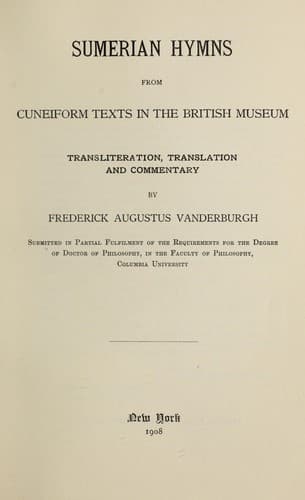
Sumerian Hymns from Cuneiform Texts in the British Museum — John Shaqi
Sumerian Hymns from Cuneiform Texts in the British Museum
Religion
Sumerian Hymns from Cuneiform Texts in the British Museum
Hymns, Sumerian; Sumerian language -- Texts
against the one who sets aside the decrees of Nebuchadnezzar or defaces
his monument.
Ramman is thought to be more truly an Assyrian than a Babylonian god. He
is almost as dear to the Assyrian as the god Ašur. Historical data,
however, do not furnish very early mention of his name in Assyria. We
find that he had a seat of worship in Damascus, and his cult had vogue
in the plain of Jezreel, his name appearing in Hebrew, written by
mistake, after the text was Masoretically vocalized, “Rimmon” which is
exactly the same in form as the Hebrew word for pomegranate. In Assyria
we can trace his history back to some extent by means of inscriptions in
which his name appears as an element in the compound names of kings. For
example, we find his name in the name of the ancient Assyrian king
Šamaš-Ramman, and from an inscription of Tiglath-pileser I. we learn
also that Šamaš-Ramman built a temple to the god Ramman. So we have
historical evidence that the cult of Ramman is older in Assyria than
this king, who was reigning in 1820 B. C. How much older it may be we do
not know. Jastrow thinks that the cult is indigenous to Assyrian soil.
Between the time of Šamaš-Ramman and the time of Tiglath-pileser I. the
service of Ramman must have declined somewhat, for the temple of Ramman
in the city of Aššur seems not to have been repaired from the days of
Šamaš-Ramman till Tiglath-pileser himself rebuilt it. Tiglath-pileser
says that from the time of the founding it was in decay six hundred and
forty years. Then king Ašurdan tore it down entirely. Sixty years after
the entire destruction, Tiglath-pileser builds the temple anew. He says
that in the beginning of his government the great gods Anu and Adad
demanded for him the restoration of their sacred dwelling. “I made
bricks and cleared its ground until I reached the artificial flat
terrace upon which the old temple had been built. I laid its foundation
upon the solid rock and the whole place incased with bricks like a
fire-place, overlaid on it a layer of fifty bricks in depth and built
upon this the foundations of the temple of Anu and Adad of large square
stones. I built it up from foundation to roof, larger and grander than
before, and erected also two great temple towers ... fitting ornaments
of their great divinities.”[25] From Tiglath-pileser on, temples of
Ramman do not seem to be often mentioned, but the god himself is
frequently spoken of in inscriptions of the kings. Sargon II. has one of
the eastern gates of his temple named “Ramman the producer of
abundance”. Ašurbânipal enumerates thirteen gods whom he honors as the
great gods, and places Ramman fifth in the list.
Public-domain text, read in full here on John Shaqi.
Reviews
Reviews
No reviews yet
Be the first to share your thoughts on this work.
Join the Discussion
Join the discussion
Sign in to leave a comment or review.
Sign InorCreate an account