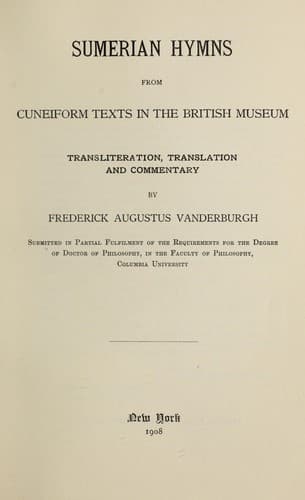
Sumerian Hymns from Cuneiform Texts in the British Museum
Religion
Sumerian Hymns from Cuneiform Texts in the British Museum
Hymns, Sumerian; Sumerian language -- Texts
Tammuz was supposed to leave the land with the season when the spring
growth was completed, to come back again in the following year. He is
considered as dead, but his death is not an absolute one. He tells the
mourners what to do as they gather about his bier. According to some
allusions he seems also to be a lord, as it were, in the bowels of the
earth, preparing the inner earth for putting forth a new stock of
vegetation, as spring shall come. Hence, the hymn to Tammuz in this
Thesis calls him “the generator of the lower world”. His association
with his friend Gišzida substantiates more fully the idea of his
resurrection. To give vitality to his work he still maintains his old
personality of sun-god, and to him again is given a seat in heaven, as
the Adapa legend shows:
“On mounting up to heaven,
At the gate of Anu
Tammuz and Gišzida were stationed.”[37]
The story of Tammuz seems to have taken deep and almost universal hold
of the imagination and sympathy of mankind. The weeping for Tammuz is
said to have been maintained by the Babylonians till a very late period.
Similar stories to that of the Tammuz legend existed in about the same
period of history among the Phoenicians, the Hebrews, the Greeks and the
Egyptians, the most of these accounts having a common origin; if they
have more than one origin, they seem nevertheless to blend in the main
into one story. It is said that in the Phoenician town of Gebal by the
Mediterranean on the road leading from the people of the east to those
of the west, there is a yearly lamentation over the death of their
sun-god, the beloved Aštoreth, who had been slain by a cruel hand, just
as the spring verdure was cut down by the hot blasts of summer. The
women, tearing their hair, disfiguring their faces and cutting their
breasts, sent up a cry to heaven: “O my brother!” Across the sea by the
way of Cyprus, the cry is said to have been carried to Greece where it
found embodiment in the story of Adonis and Aphrodite. Possibly,
however, the Greek story may be indigenous. Adonis lost his life while
hunting, thrust through the thigh with the tusk of a wild boar. After
death he was in great favour with Persephone who finally yielded to the
entreaties of the inconsolable Aphrodite, and Adonis spent one half of
the year with his celestial mistress and the other half with his
infernal one. How much place the annual weeping for a departed one had
among the Hebrews may be inferred to some extent by the mention made in
the Scriptures of the service. Zechariah speaks of the well-known
mourning of Hadadrimmon in the valley of Megiddon, and Amos refers to
the custom of mourning for an only son. Ezekiel says that the Lord
brought him to Jehovah’s house “and behold, there sat the women weeping
for Tammuz”. Jeremiah goes a step further and gives us the refrain which
was used in the weeping: “Ah me! Ah my brother!” The parallel story in
Egypt had for its hero the god Osiris who, representing goodness, upon
Public-domain text, read in full here on John Shaqi.
Reviews
Reviews
No reviews yet
Be the first to share your thoughts on this work.
Join the Discussion
Join the discussion
Sign in to leave a comment or review.
Sign InorCreate an account