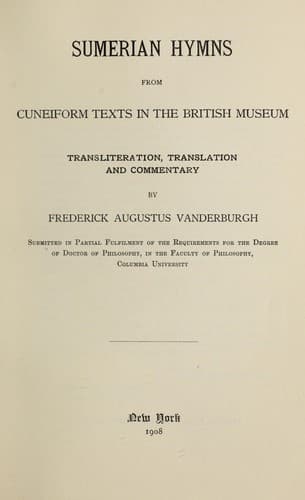
Sumerian Hymns from Cuneiform Texts in the British Museum
Religion
Sumerian Hymns from Cuneiform Texts in the British Museum
Hymns, Sumerian; Sumerian language -- Texts
There is no mention of any city in the hymn, as there is in the hymn to
Sin, but this hymn probably had its origin in Nippur which was the great
religious centre of Babylonia in the pre-dynastic period, when kings
ascribed their successes to Bêl and brought their booty to Nippur,
calling Bêl “the lord of the lands.”
Obverse
1. _ù-mu-un na-àm-zu-ka na-àm ..... še-ir-ma-al nì-[te-na]_
O lord of wisdom, ........... supreme by thyself!
_ù-mu-un_ means “being lord”, _ù_ equalling “lord” and _mu-un_ equalling
“being”. _ù-mu-un_ is a phonetic representation of _umun = bêlu_, (Br.
9475). _umun_ is sometimes ideographically represented by the sign
GIGURÛ, the corner wedge (Br. 8659), which signifies “depress”,
“overpower”, “be powerful”, “rule”. _umun_ may be shortened either to
_u_, _mun_ or _un_, giving to GIGURÛ three values for “lord”, _u_, _un_
and _umun_. _umun_, which is ES, has an EK value, _ugun_. In line 17, we
shall meet with another word for “lord”; viz., _ga-šá-an_.
_ù_: the sign IGI-DIBBU alone means “lord”. It has a well-known Assyrian
equivalent, _labâru_, “be old”, (Br. 9464). Brummer explains the sign
correctly as follows: IGI-DIBBU is a compound sign and equals ŠI, “eye”,
plus LU, “take away”, hence the meaning “take away the eye”, “become
old”, “elderly”, “lord”, (SVA. 2-7).
_mu-un_ contracted to _mun_ is cognate with _me-en_ which equals _bašû_,
“to be”, as in _za-e-me-en_ (Br. 10404). We shall meet the form _mu-un_
as a verbal prefix.
_mu_ here is simply a dialectic form of _me_ (MSL., p. 240). _mu_ as a
Sumerian value is attested by the sign-name MU. We shall meet with MU in
the name _Mu-ul-lil_, also as a suffix and in other ways. The MU of our
text is old Babylonian. It is the MU of Ur-Gur and Gudea (see brick of
Ur-Gur, No. 90009, CT. XXI, and Gudea’s Cylinder A, Col. XVIII, line 27,
in Déc. 36).
_un_ is plainly cognate with _en_ which is so commonly represented by
the sign ÊNU. The sign UN we shall meet again with the value _kalama_.
The UN of our text is a very ancient sign (see Cone of Eannatum, Col. I,
CT. XXI, Tablet 30062).
_na-àm-zu-ka_ consists of noun, _na-àm-zu_ and postposition _ka_.
_na-àm-zu_ is an abstract noun composed of the abstract prefix _na-àm_
and the stem _zu_.
_na-àm_ equals _šîmtu_, “fortune”, (Br. 1609 and HW. 654) and is a
dialectic form of _nam_ (Br. 2103) which is a common abstract prefix.
_na_ is a Sumerian value of the sign NANÛ. The value is simply syllabic
here. The sign originally signified “stone”. Our NA is found both in old
Babylonian tablets and in New-Babylonian inscriptions.
_àm_ (ES) also is only syllabic here. The sign has the EK value _ag_ and
is used ideographically.
_zu_: the sign representing _zu_ has only one value, presenting a rather
uncommon circumstance in Sumerian. _zu_ means “know”, also “be wise”,
and may equal _nîmeḳu_, “wisdom”, (Br. 136), but the author preferred to
say _na-àm-zu_, “the fortune of wisdom”.
Public-domain text, read in full here on John Shaqi.
Reviews
Reviews
No reviews yet
Be the first to share your thoughts on this work.
Join the Discussion
Join the discussion
Sign in to leave a comment or review.
Sign InorCreate an account