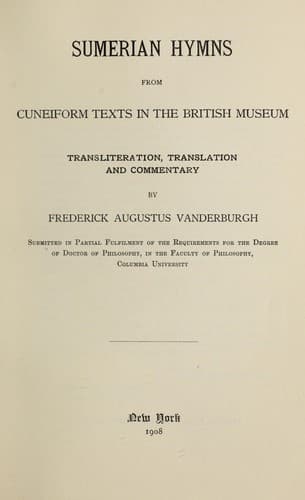
Sumerian Hymns from Cuneiform Texts in the British Museum — John Shaqi
Sumerian Hymns from Cuneiform Texts in the British Museum
Religion
Sumerian Hymns from Cuneiform Texts in the British Museum
Hymns, Sumerian; Sumerian language -- Texts
_ka_, sign-name KÂGU, is a postpositive sign of the genitive. The sign
KÂGU (discussed below) is often used in this way, but it has several
values and is used to express a large number of ideas, _ka_ as a
postposition is a dialectic form of _ge_(KIT).
_še-ir-ma-al_ is ES for the EK _nir-gal_, _š_ changing to _n_ and _m_ to
_g_ (MSL. p. XI). It is translated into Assyrian by the word _etellu_.
_še-ir-ma-al_ consists then of two parts; stem _še-ir_ and suffix
_ma-al_. Strictly, _še-ir_ is “lord” and _še-ir-ma-al_ is “lordship”.
_še-ir_: _e_ and _i_ appear generally to be distinct sounds, but they
combine, just as the two _u_’s combine in _mu-un_, making _mun_, and as
the two _a_’s combine in _na-àm_, making _nam_. Evidently the weaker
sound is absorbed by the stronger, hence _še-ir_ becomes _šêr_, “ruler”,
which could be represented by NISIGÙ (JA., 1905, p. 113, also Br. 4306).
_še_ is perhaps a Semitic value coming from _šê’u_, “grain”. The
original sign is a picture of a head of grain like wheat or oats. The
name of the sign is Û-UM. The sign occurs in line 20 as an ideogram.
_ir_ is also Semitic value of the sign GAḲ-GUNÙ. We shall meet the sign
used as a verb equal to _kamû_, “bind”.
_ma-al_, phonetically written for _mal_, is an ending which adds to
_šêr_ the idea of “having”; hence _še-ir-ma-al_ means “having rule”.
_ma_: we shall find MAMÛ used mostly as a noun, but it may occur as a
verbal prefix or as a phonetic complement.
_al_: the sign has only one value, _al_, whose use is principally
syllabic. The sign-name is ALLU.
_nì-te-na_: nì-te is the main word with _na_ as a suffix.
_nì-te_: _nì_ and _te_ stand related to each other as object and cognate
verb, meaning “fear a fear”. The affinity of _nì_ and _te_ is shown by
the fact that the sign for _nì_, called IMMU, may have the value _tu_
(see Br. 8355), then the object and verb would be _tu-te_, “fear a fear”
(see Fossey in JA., 1905, p. 128). _nì-te_ may mean “self” just as _nì_
may stand not only for “fear” but for that which causes fear as
_Rammânu_, “the storm-god”, and then by way of erroneous association for
_ramânu_, “self”.
_nì_: the sign IMMU is one of the principal signs that originally
denoted “the quarter of the heavens”. It is used to signify “storm” and
many ideas connected with storm.
_te_: TÊMMÊNU originally meant “orientation”, then “to approach
hostilely”; hence _nì-te_ meant “approach of storm”.
_na_ is an indeterminate suffix, but the context shows that it means
“thy”, so that _nì-te-na_ means “thyself” (see _na_ above).
2. _^dimmer Mu-ul-lil ù-mu-un na-àm-zu-ka ... še-ir-ma-al nì-te-na_
O Bêl, lord of wisdom, ........ supreme by thyself!
Public-domain text, read in full here on John Shaqi.
Reviews
Reviews
No reviews yet
Be the first to share your thoughts on this work.
Join the Discussion
Join the discussion
Sign in to leave a comment or review.
Sign InorCreate an account