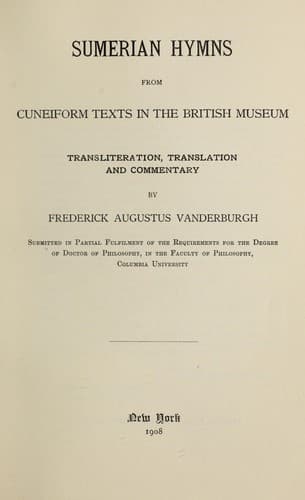
Sumerian Hymns from Cuneiform Texts in the British Museum
Religion
Sumerian Hymns from Cuneiform Texts in the British Museum
Hymns, Sumerian; Sumerian language -- Texts
_kur_: the sign KÛRU in the old linear form represented pictorially
“mountain tops”. The value _kur_ has three very common Assyrian
equivalents, _šadû_, “mountain”, _ir⋅itu_, “earth” and _mâtu_, “land”,
all closely related to each other.
_ra_ is a common postposition signifying “unto”. Perhaps _ra_ sometimes
serves merely as a vowel of prolongation, the _r_ at the same time
making a double of the final consonant of the preceding word. In such a
case _ra_ is called a phonetic complement, while it also helps to
determine the value of the sign immediately preceding. To illustrate,
the sign KÙRU being followed by RARÛ cannot be read _gin_ nor _mad_.
_ra_ can also be the sign of the genitive (Br. 6367).
4. _a-a ^dimmer Mu-ul-lil à-mu-un dug-ga zi-da_
O father Bêl, lord of righteous command!
_a-a ^dimmer Mu-ul-lil ù-mu-un_ (explained in lines 1, 2 and 3).
_dug-ga_: _dug_ is the value of KÂGU to be used here, as is at once
suggested by the phonetic complement _ga_.
_dug_: a very common meaning of _dug_ is _ḳibîtu_, “command” (Br. 532).
_ga_ is merely the vowel of prolongation _a_ with the final _g_ of the
preceding stem.
_zi-da_: _zi_ being followed by _da_ gives the impression that it should
be read _zid_ with _da_ as a phonetic complement. A final consonant in
the first syllable, however, is not always a necessity. The name of the
temple of Nabu at Borsippa is not read _È-zid-da_, but _È-zi-da_ or
_È-zida_.
_zi_ here equals _imnu_, “right”. It may sometimes equal _napištu_ (see
below, line 25).
5. _a-a ^dimmer Mu-ul-lil siba sag gig-ga_
O father Bêl, shepherd of the blackheaded!
_siba_ equals _rê’û_ (Br. 5688). The sign is compounded from PA and LU
and means “staff-bearer”, since PA signifies “staff” and LU means
“hold”, “seize”. The use of the sign is confined almost entirely to the
idea of shepherd of animals and then figuratively to that of governor of
men.
_sag_: the sign with the value _sag_, called SANGU or SAGGU, is the
common sign to represent “head” which is expressed in Assyrian either by
_rêšu_ or _ḳaḳḳadu_ (see Br. 3522 and 3513). The sign occurs in many
compounds.
_gig-ga_: _gig_ is the value of MI suggested by the phonetic complement
_ga_.
_gig_: the sign is composed of the corner wedge U and the sign TATTAB
and means “darkness”. The sign really signifies “entering into
depression”. _gi_ perhaps is a dialectism for _mi_.
Public-domain text, read in full here on John Shaqi.
Reviews
Reviews
No reviews yet
Be the first to share your thoughts on this work.
Join the Discussion
Join the discussion
Sign in to leave a comment or review.
Sign InorCreate an account