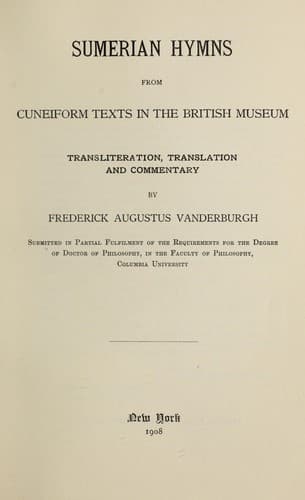
Sumerian Hymns from Cuneiform Texts in the British Museum
Religion
Sumerian Hymns from Cuneiform Texts in the British Museum
Hymns, Sumerian; Sumerian language -- Texts
_^dimmer_: the sign AN here has the value _dimmer_. In the great
bilingual penitential Psalm, K. 2811 (IV R. plate 10), instead of the
single sign AN, we have the spelling _dim-me-er_ (see lines 3, 7 and
others). If this were an EK composition, the sign AN might be _dingir_,
_di-in-gir_, but in the words _ù-mu-un_ and _še-ir-ma-al_ which we have
already had, we have evidence that this is an ES composition, hence AN
here is to be read _dimmer_.
_Mu-ul-lil_: Bêl has only one name in this hymn; namely, _Mul-lil_. In
the two tablets, 29644 and 29623, following this tablet, Bêl is called
_En-lil_ (see the colophons). The word _Mu-ul-lil_ divides into two
parts, _Mu-ul_, which contracts into _Mul_, and _lil_.
_Mu-ul_: _Mul_ is ES; _En_ is EK. Both _Mul_ and _En_ mean “lord”, so
that either _Mul-lil_ or _En-lil_ means “lord of fulness”. It is
probable that _mul_ (_wul_) is cognate with _en_ (el).
_mu_ (as a value is discussed in line 1).
_ul_: the sign is composed of GÊŠPU and GUṬṬU. The value _ul_ is
Semitic. We shall meet below this sign with the value _rù_ meaning
“perfect”.
_lil_: the name of the sign is KÎTU. _lil_ in magic writings means
“demon”, i. e., a spirit which may be either good or bad. Originally the
sign indicated “structure”, from which idea comes the postpositional use
of the sign with the value _ge_. _šâru_, “wind”, with the value _lil_ is
a secondary meaning of the sign.
_ù-mu-un na-àm-zu-ka_ (occurring in line 1, was discussed there). The
fragments following _-ka_ do not give a sure clue as to what the signs
were before the erasure. After _^dimmer Mu-ul-lil_ perhaps the whole of
the second line was precisely like the first.
_še-ir-ma-al nì-te-na_ (explained in line 1).
3. _a-a ^dimmer Mu-ul-lil ù-mu-un-e kur-kur-ra_
O father Bêl, lord of the lands!
_a-a_ is probably for _ad-da_, _ad_ meaning “protector”. Exactly how
_a-a_ comes to be used in the place of _ad-da_ may not be determined
with certainty. The explanation may lie in the relation between “water”,
“seed” and “father”. _a-a_ also seems to be a softened form of _ad-da_.
_a_ means “seed” or more primarily “water”. The sign is an ideographic
picture of dripping water.
_^dimmer Mu-ul-lil_ (explained in line 2).
_ù-mu-un-e_ divides into the word _ù-mu-un_ and the prolongation vowel
_e_, possibly demonstrative in sense (see _e_ farther on).
_ù-mu-un_ is not elsewhere in this hymn lengthened to _ù-mu-un-e_, but
_ù-mu-un_ occurs nine times.
_kur-kur-ra_ is the plural form of noun, _kur_, plus postposition _ra_.
_kur-kur_: in Sumerian the general way of denoting the plural in nouns
is by doubling the root (see ASK. p. 140), whereas the doubled root in a
verb means an intensified or causative stem. There are five other cases
of doubling the root in the hymn: _di-di_, line 7, _ma-ma_, line 8,
_ir-ir_, line 13, _má-má_, line 20; and _da-da_, line 23.
Public-domain text, read in full here on John Shaqi.
Reviews
Reviews
No reviews yet
Be the first to share your thoughts on this work.
Join the Discussion
Join the discussion
Sign in to leave a comment or review.
Sign InorCreate an account