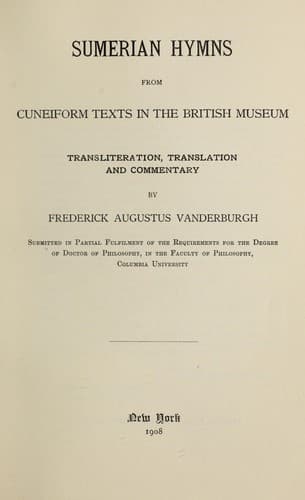
Sumerian Hymns from Cuneiform Texts in the British Museum
Religion
Sumerian Hymns from Cuneiform Texts in the British Museum
Hymns, Sumerian; Sumerian language -- Texts
This beautiful and interesting hymn begins with a picturesque and lordly
epithet of the god whose full face so often shone upon the worshipper
night by night. His fatherly nature and his full-orbed glory are dwelt
upon in adoring and glowing terms. The name of his city and temple are
mentioned. His power to lighten the world is acknowledged. His peculiar
relation of “son to Bêl” is announced. The phenomenon of his appearance
in the heavens as the _full moon_ is described to us from several points
of view. This is the famous Nannar, dwelling in the temple of
E-gišširgal at the ancient city of Ur. The sacred ship, becoming a
peculiar emblem in Babylonian worship, symbolized several important
ideas connected with Nannar’s transit through the heavens by night or
during the month. Perhaps Nannar was in the beginning a water-god. His
power over the waters is graphically described.
Obverse
1. _mà-gur azag an-na še-ir-ma-al nì-te-na_
O shining ship of the heavens, majestic by thyself!
_mà-gur_ is a boat of crescent form. Sin is a man sitting in the half
circle of the moon and sailing across the firmament of the heavens as in
a majestic ship. _mà_: the sign MÙ was originally pictorial and
represented the rudder of the ship. The sign of our tablet is
New-Babylonian and can be found in the inscriptions of Nebuchadrezzar
II. It is half way between the old pictorial and the usual Assyrian MÙ.
_gur_: the sign ḤAR probably refers to the body of the ship as “an
enclosure”, or more particularly to “the crescent form” of the ship,
since ḤAR means “circular enclosure”. The ḤAR of our text is much like
the linear form found in the _Stèle des Vautours_.
_azag_ equals _ellu_, “shining”, (Br. 9890). The sign also has the value
_ku_ with the meaning _ellu_. _azag_, “shining”, refers to the moon and
the moon looks like a ship.
_an-na_ (see Hymn to Bêl, line 18).
_še-ir-ma-al nì-te-na_ (see Hymn to Bêl, line 1). The ideas of these two
words find their way into the first line of the Ašurbânipal Hymn to Sin,
K. 2861, (IV R. 9). _še-ir-ma-al_ appears especially as _ner-gal_ (_š-n_
and _m-g_) and _nì-te-na_ as _aš-ni maḥ-àm_; _e-diš-ši-šu ⋅i-i-ru_.
2. _a-a ^dimmer Šis-^ki ù-mu-un-e Šis-unu-^ki-ma_
O father Nannar, lord of Ur!
_a-a_ (see Hymn to Bêl, line 3).
_^dimmer Šis-^ki_ is the most common Sumerian name of the god Sin, and
means “brother of the land”. Sin was probably looked upon as “the helper
of earth”. _^dimmer_ (see Hymn to Bêl, line 2). _Šis_ equals _aḥu_,
“brother”, (Br. 6437). _ŠIŠ_ sometimes has the value _uru_, especially
when it means _na⋅âru_, “keep”. The _ŠIŠ_ of our hymn is New-Babylonian
but is not essentially different from the _ŠIŠ_ of Gudea. _ki_ (see Hymn
to Bêl, line 9).
_ù-mu-un-e_ (see Hymn to Bêl, line 3).
Public-domain text, read in full here on John Shaqi.
Reviews
Reviews
No reviews yet
Be the first to share your thoughts on this work.
Join the Discussion
Join the discussion
Sign in to leave a comment or review.
Sign InorCreate an account