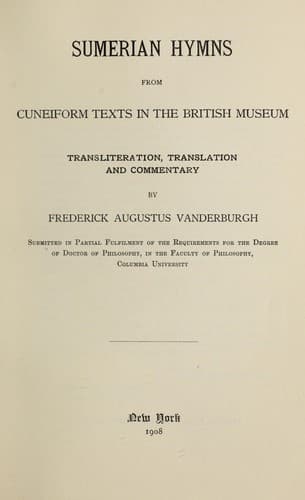
Sumerian Hymns from Cuneiform Texts in the British Museum
Religion
Sumerian Hymns from Cuneiform Texts in the British Museum
Hymns, Sumerian; Sumerian language -- Texts
_Šis-unu-^ki-ma_ means “of the brother’s dwelling place”. _Šis_ means
“brother”. _unu_ equals _šubtu_, “dwelling”, (Br. 4792). _ma_, perhaps,
can be taken as a sign of the genitive, being dialectic for _ga_, which
is for _ge_, one of the values of KIT (see MSL. pp. XI and XVI). Perhaps
we ought to read this word _Uru-um-^ki-ma_, taking the other value of
ŠIŠ and also reading _um_ instead of _unu_. In texts of OBI. it would
appear that UNU is closely related to UM as well as to AB.
3. _a-a ^dimmer Šis-^ki ù-mu-un-e È(BIT)-ner-nu-gál(IG)_
O father Nannar, lord of E-gišširgal!
_a-a ^dimmer Šis-^ki ù-mu-un-e_ (see line 2).
_È-ner-nu-gál_ is not the usual spelling. The more common form is
_È-giš-šir-gal_. Our _È(BIT)-ner(NER)-nu(NU)-gál(IG)_ which also occurs
in Ḥammurabi (for example, in CḤ. Col. II, line 21, Plate II) is
dialectic for _È(BIT)-giš(IZ)-šir(ŠIR)-gal(GAL)_.
_È(BIT)-giš(IZ)-šir(ŠIR)-gal(GAL)_ is the spelling found in the
Ašurbânipal Hymn. In the inscription of the Clay Cylinder of Nabonidus
found at Ur (Col. I, line 30), the spelling is
_È(BIT)-giš(IZ)-šir(ŠIR)-gal(GAL)_, but the margin has the spelling
_È(BIT)-giš(IZ)-nu(NU)-gál(IG)_. _È_ equals _bîtu_, “house”, (Br. 6238).
_ner_ evidently stands for _kiš_. These two values, _ner_ and _kiš_,
were represented by the same sign in old Babylonian; namely, PIRIḲḲU.
From the sign PIRIḲḲU, there developed in Assyrian another sign, whose
chief value is _kiš_ with the meaning _kiššatu_. The sign here then
should have the value _kiš_, or in old Babylonian _giš_, which is also
one of the values of GISSU, a determinative before the name of a light.
_nu_ is for _šir_ which equals _nûru_, “light”. IṢ.ŠIR is a common
ideogram for “light”. The interchange of NU and SIRU is not so easy to
explain. The fact that NU instead of SIRU occurs in the name of the
temple in the time of Ḥammurabi would go to show that the spelling of
the word with NU is more primitive than the spelling with SIRU. Perhaps
NU has a value _šir_. Brünnow recognizes the fact that NU in the name of
the temple sometimes takes the place of SIRU (see Br. 2005 and 1657).
There is a difference between IḲU and GALLU. IḲU equals _bašû_, while
GALLU equals _rabû_. The _gal_ (ES _mal_) of IḲU must be different from
the _gal_ of GALLU.
4. _a-a ^dimmer Šis-^ki ù-mu-un ^dimmer Áš-suḥ-ud_
O father Nannar, lord of Namra⋅it!
_a-a ^dimmer Šis-^ki ù-mu-un_ (see line 2).
_^dimmer Áš-suḥ-ud_: one of the citations Brünnow gives, in which the
name of this god occurs, is in Incantation K. 3255 (IV R.² 2, 21),
where, in the Sumerian as well as in the marginal reading of the
Assyrian, Sin is said to be the lord of the god Namra⋅it. _^dimmer
En-zu-na en ^dimmer Áš-suḥ-ud ra-ge_ = _^ilu Sin be-el Nam-ra-⋅i-it_.
_Áš-suḥ-ud_ means “the only foundation of light”. _Áš_ has a very common
Assyrian equivalent _edu_, “one”. _suḥ_ equals _išdu_, “foundation”,
(Br. 4811). _ud_ equals _urru_, “light”, (see Br. 7798).
Public-domain text, read in full here on John Shaqi.
Reviews
Reviews
No reviews yet
Be the first to share your thoughts on this work.
Join the Discussion
Join the discussion
Sign in to leave a comment or review.
Sign InorCreate an account