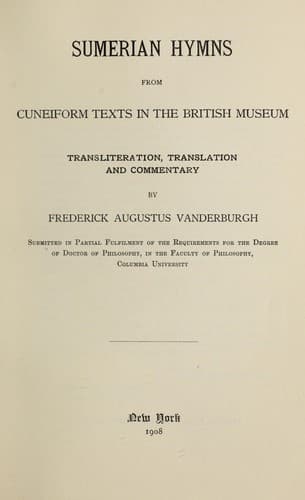
Sumerian Hymns from Cuneiform Texts in the British Museum — John Shaqi
Sumerian Hymns from Cuneiform Texts in the British Museum
Religion
Sumerian Hymns from Cuneiform Texts in the British Museum
Hymns, Sumerian; Sumerian language -- Texts
_síg-ga-zu-ne_ (see line 6).
_za-e_ (see line 10). It may be noticed that _síg-ga-zu-ne_ occurs three
times in this line and ten times in the section, lines 6-18. This
repetition no doubt serves for rhetorical effect, especially in oral
delivery and, together with the marked uniformity of measure in the
clauses, characterizes the passage as poetic.
13. _síg-ga-zu-ne bi-šag-a-zu-ne za-e síg-ga-zu-ne_
When thou art full, when thou speakest favorably, thou, when thou
art full,
_síg-ga-zu-ne_ (see line 6).
_bi-šag-a-zu-ne_ is a _ḥal_-clause equal to “in thy speaking
graciously”. _bi_ equals _ḳibû_, “speak”, (Br. 5124). Starting with the
meaning “speak” the sign KŠU comes to have a demonstrative force and is
generally used as a suffix of the third person singular. We shall also
see that it sometimes equals _šikaru_ “strong drink”. _šag_: the sign
giving this value is one not much used. It may be identified as GIŠIMMAR
(see AL. p. 130, No. 206, also Br. 7286). _šag_ is the chief value,
equal to _damâḳu_ or _damḳu_, “gracious”. _a_: the value is generally
followed by the phonetic complement _ga_, but here it is followed by _a_
(see Hymn to Bêl, line 9). _zu-ne_ (see line 6).
14. _bi-šag-a rù-ti-a-zu-ne za-e síg-ga-zu-ne_
When thou speakest graciously and engenderest life, thou, when thou
art full,
_bi-šag-a_ (see line 13).
_rù-ti-a-zu-ne_ is a _ḥal_-clause equal to “in thy engendering life”.
_rù_: we have had UL already as a composite part of _Mu-ul-lil_ (see
Hymn to Bêl, line 2). UL here probably with the value _rù_ equals
_kalâlu_, “perfect”. The sign is intended to be the picture of a goring
bull; then, as we get away from the primary idea, there arise the
meanings of “exultation”, “perfection”, etc. Nannar is “the perfecter of
life”. _ti_ (see Hymn to Bêl, line 16). _a_ (see Hymn to Bêl, line 9).
_zu-ne_ (see line 6).
_za-e_ (see line 10).
_síg-ga-zu-ne_ (see line 6).
15. _a-a ^dimmer Šis-^ki lid damal lid-ne-ra sal-dug-ga-zu-ne_
O father Nannar of extensive progeny, when thou speakest to that
progeny,
_a-a ^dimmer Šis-^ki_ (see on line 2).
_lid_ may be of Semitic origin from the Assyrian word _littu_,
“progeny”. The two horizontal lines in the sign suggest the idea of
“pairing”, from which comes the idea of “progeny” (thus, Prince, MSL.,
p. 223).
_damal_ (see Hymn to Bêl, line 10).
_lid-ne-ra_ equals “to that progeny”. _ne_ equals _annû_, a
demonstrative pronoun “this”. _ne_ is cognate with _de_ which is also
cognate with _da_ and _ta_ used as postpositions (see _de_ and _da_ in
Hymn to Bêl, lines 6 and 4). _ra_ is a postposition = “unto” (see Hymn
to Bêl, line 3).
Public-domain text, read in full here on John Shaqi.
Reviews
Reviews
No reviews yet
Be the first to share your thoughts on this work.
Join the Discussion
Join the discussion
Sign in to leave a comment or review.
Sign InorCreate an account