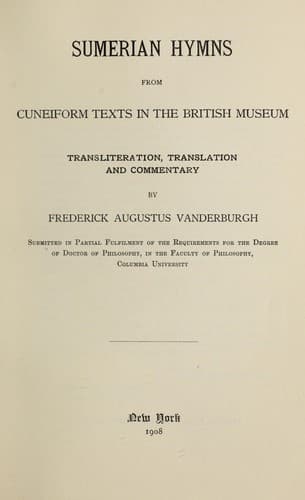
Sumerian Hymns from Cuneiform Texts in the British Museum
Religion
Sumerian Hymns from Cuneiform Texts in the British Museum
Hymns, Sumerian; Sumerian language -- Texts
_sal-dug-ga-zu-ne_ is a _ḥal_-clause: “in thy speaking”. _sal_ is a
prefix of an abstract character. It is equivalent to the Assyrian
_zinništu_, “feminine”. It is a counterpart to _ku_ in the expressions
_Eme-sal_ and _Eme-ku_, _ku_ being equal to _bêlu_, “lord”. As a prefix,
_sal_ generalizes the root-idea of the stem to which it is attached and
is consequently an abstract prefix (see Br. 10930, 10949 and 10955).
_dug-ga_ (see Hymn to Bêl, line 4). _zu-ne_ (see line 6).
16. _a-a-zu ide ḥùl-la mu-e-ši-in-maš sal-zi ma-ra ni-in-gú_
Thy father discerns the joyful face and speaks life to the land.
_a-a-zu_ (see on line 7).
_ide_ equals _pânu_, “face”, (Br. 9281). The sign IGÛ can be read either
_ide_, which is ES, or _ige_, which is EK.
_ḥùl-la_ equals noun _ḥùl_, plus phonetic complement _la_. _ḥùl_ equals
_ḥadû_, “joy” (Br. 10884). The sign giving this value is not to be
confounded with another sign which also has the value _ḥul_ meaning
“evil”, expressed by _limuttu_ (Br. 9503).
_mu-e-ši-in-maš_ is a verb consisting of verbal prefix _mu_, verbal
infixes _e_ and _ši-in_ and root _maš_. _mu_ (see Hymn to Bêl, lines 1
and 18). _e_ (see Hymn to Bêl, line 18). _ši-in_: an objective verbal
infix naturally has its person determined by the object to which it
refers. That object in this case seems to be _ide ḥùl-la_, “the joyful
face” of the moon. _maš_: the sign has two names, BÂRU and MŠU, and two
chief values related to these names, _bar_ and _maš_. _bar_ and _maš_
are cognate forms. _b_ changes to _m_ (MSL. p. X); _r_ changes to _š_
(MSL. p. XII). The sign has two chief meanings, “side” and “cut”. The
meaning of “side” is represented by _bar_ (see MSL. p. 234), while the
meaning of “cut”, from which we get the idea of “distinguish” is
generally represented by the value _maš_ (Br. 1735).
_sal-zi_ consists of abstract prefix _sal_ and noun _zi_. _sal_ (see on
line 15). _zi_ (see on line 8).
_ma-ra_ equals “unto the land”. _ma_ (see Hymn to Bêl, line 8). _ra_
(see line 15).
_ni-in-gú_: _ni_ can be a verbal prefix and _in_ a verbal infix, or
_ni-in_ can be a verbal infix with the verbal prefix omitted, _gú_ being
the verbal root. _ni_, if taken as a prefix, naturally refers to
_a-a-zu_. _ni_ may have a demonstrative force, equal to _šuatu_, like
_ne_. _in_ as an infix refers to _ma-ra_. _gú_, a shortened form of
_gug_, equal either _ḳìbû_, “speak”, or _apâlu_, “answer”. _gú_ and
_gug_ have dialectic forms _du_ and _dug_, the _g_ changing to _d_ which
ES prefers. The sign is apparently a modification of the sign SANGU (see
AL. p. 121, No. 14, and p. 124, No. 87). The primary meaning was
“opening” and the leading value is _ka_ equal to _pû_, “mouth”. The
values _ka_ and _gú_ come from the sign-name KÂGU (see Hymn to Bêl,
lines 1 and 4). With the value _ì_ the sign means “word”.
17. _e i-i lugal-ra û-de-eš e mu-un-ê_
As an exalted royal command, daily he causes the word to go forth!
_e_ (see Hymn to Bêl, line 14).
Public-domain text, read in full here on John Shaqi.
Reviews
Reviews
No reviews yet
Be the first to share your thoughts on this work.
Join the Discussion
Join the discussion
Sign in to leave a comment or review.
Sign InorCreate an account