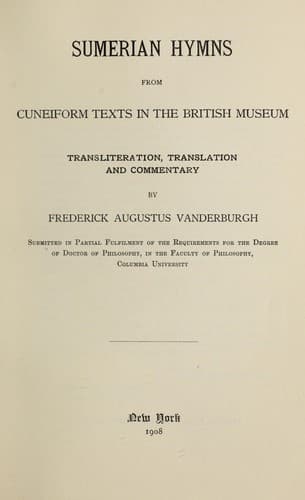
Sumerian Hymns from Cuneiform Texts in the British Museum
Religion
Sumerian Hymns from Cuneiform Texts in the British Museum
Hymns, Sumerian; Sumerian language -- Texts
30. _eri-ta an-na-ta gar(ŠÂ)-ra-ni û(UD) ì(KA)-ḥar-ra na-nam_
When he establishes himself out of the city out of heaven, he fixes
the day of curse.
31. _... êr(A.ŠI) lim(LIB)-ma ^dimmer Mer(IM)_
..... Hymn to Adad.
This hymn we find to be full of action. The lightning flashes in the
first line, and we see at least three distinct kinds of storm placed on
the scene, one succeeding the other. The thunder storm first passes over
our head. We see the lightning, we hear the roar of the thunder, the
earth is placed in fear, the day turns dark, the top of the mountain is
smitten, the very gods themselves are terrified. Secondly comes the
flood. The storm of the hour is lengthened into one of days. It becomes
a deluge of judgment on the earth. The words say seven days, but in such
poetic discourse seven might perhaps simply mean “many”. Finally, there
is a decided change in the scene. The flood has passed away. The
death-destroying hail-storm falls upon us, not simply the little
hail-stones, but the great hail-stones. The day, of course, has come.
But the effects of Adad’s power so artistically set forth in this hymn
are secondary, as placed beside the dignity of the god himself. The word
of Adad is absolute and all-powerful. He is a god of great wrath. He is
a real bull-god, of heaven and earth. He can put the heavens out of
sight. He can make day as black as the darkest night. He can split the
earth with his lightning. He can flood the land with water. He can pelt
its inhabitants with stones. Yet in all this he consults with father
Bêl.
Obverse
1. _[ḥad]-ê-a mu-zu an[-zak-ku]_
In the lightning flash thou proclaimest thy name!
_ḥad-ê-a_ is a _ḥal_-clause, consisting of noun _ḥad_, participle _ê_
and postposition _a_, and means “in the going out of the sceptre”, or
freely, “in the lightning flash”. The apodosis is _mu-zu an-zak-ku_.
_ḥad_ (PA) equals _ḥaṭṭu_, “sceptre” (Br. 5573). The value _ḥad_ may be
of Semitic origin, but note that its cognate _ḥud_ is equal to _namûru_,
“brightness” (Br. 5582), as is also _kun_, another value of PA “staff”;
then PA = “a lighted torch”. _ê_ we have had as equal to _a⋅û_ (Hymn to
Bêl, line 15). _ê_ is also equal to _šûpû_, “flashing” (Br. 5638). _a_
equals _ina_, “in” (Br. 11365).
_mu-zu_ means “thy name”. _mu_ equals _šumu_, “name” (Br. 1235).
Public-domain text, read in full here on John Shaqi.
Reviews
Reviews
No reviews yet
Be the first to share your thoughts on this work.
Join the Discussion
Join the discussion
Sign in to leave a comment or review.
Sign InorCreate an account