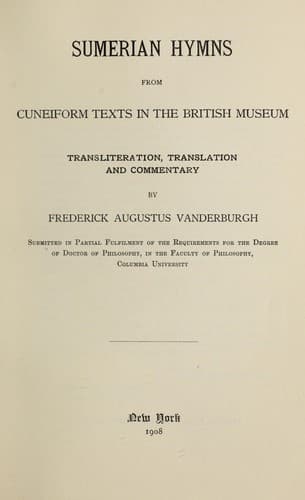
Sumerian Hymns from Cuneiform Texts in the British Museum
Religion
Sumerian Hymns from Cuneiform Texts in the British Museum
Hymns, Sumerian; Sumerian language -- Texts
_an-zak-ku_ is a verb. _an_ is an indeterminate verbal prefix. The
context shows it to be of the second person (see MSL. p. XXVI). _zak-ku_
may mean “utter a decree” (Br. 6519). For example, _zak_ equals
_tamîtu_, “a decree” (Br. 6493). Perhaps it could as well be a verb
signifying “to decree”, or “to establish”. _ku_ also equals _tamû_,
“utter” (Br. 10555), but it would be simpler to make _ku_ a phonetic
complement to _zak_. It may be that we ought to read the clause: “thy
name utters the decree”. But “thy name” has the usual position of the
object. It is also rather awkward to regard _zak_ as an object placed
between the verbal prefix and the verb.
2. _^dimmer Mer bi-maḥ ḥad-ê-a mu-zu an[-zak-ku]_
O Adad, in the mighty thunder and the lightning flash thou declarest
thy name.
_^dimmer Mer_: this is the Sumerian name of the storm-god. _Mer_ being
one of the values of the sign IMMU. The fact that the sign in some cases
in this hymn (e. g. lines 15 and 17) is followed by the phonetic
complement _ri_ or _ra_ shows that _Mer_ is the value intended for the
name of the god. _Mer_ is probably from _imi_ changed to _immer_ and
then to _Mer_ and hence, like _imi_, means “wind” and “storm”. The name
_Mer_ offers no suggestion as to the origin of the Semitic names
_Rammânu_ and _Addu_.
_bi-maḥ_ equals “mighty utterance”. _bi_ (see Hymn to Sin, line 13).
_maḥ_ (see Hymn to Bêl, line 23).
_ḥad-ê-a mu-zu an-zak-ku_ (see on line 1).
3. _[^dimmer] Mer dumu An-na bi-maḥ ḥad-ê-a mu-zu an-sa[k-ku]_
O Adad, son of Anu, in the mighty thunder and the lightning flash
thou declarest thy name.
_dumu_ (see Hymn to Sin, line 5, _ṭu-mu_).
_An-na_, ideogram for the god of heaven, plus phonetic complement. Note
that AN for the god Anu does not take the determinative god sign.
Probably the omission is due to the desire to avoid the occurrence of AN
twice in succession. It must have been after Adad had taken the place of
Ištar in the second triad of gods that Adad was called the son of Anu.
The earlier arrangement was Anu, Bêl, Ea, Sin, Šamaš and Ištar. The
later order was Anu, Bêl and Ea, as rulers of the universe, and Sin,
Šamaš and Adad, as rulers of heaven under the command of Anu. This new
grouping was the result of a theological development. Ištar was found to
be one of the planets, and, therefore, not to be classed longer along
with Sin and Šamaš. Adad, the god of the atmosphere, was thought to be a
personality of sufficient dignity to take the place formerly occupied by
Ištar.
_bi-maḥ ḥad-ê-a mu-zu an-zak-ku_ (see on lines 1 and 2).
4. _ù-mu-un nì-ki-ge bi-maḥ ḥad-ê-a mu-zu an-zak[-ku]_
O lord, dread of earth, in the mighty thunder and the lightning
flash thou declarest thy name.
_ù-mu-un_ (see Hymn to Bêl, line 1).
Public-domain text, read in full here on John Shaqi.
Reviews
Reviews
No reviews yet
Be the first to share your thoughts on this work.
Join the Discussion
Join the discussion
Sign in to leave a comment or review.
Sign InorCreate an account