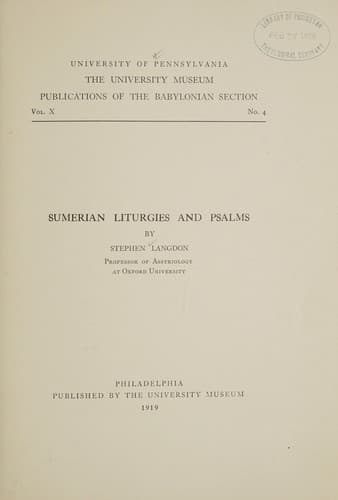
Hymns, Sumerian; Sumerian language -- Texts; Sumerians -- Religion
The only Sumerian cult songs to deified kings not in the Nippur collection
have now been translated by the writer and made accessible for wider
study. One hymn to Ur-Engur which proves that he had been canonized at his
capitol in Ur will be found in the _Proceedings of the Society of Biblical
Literature_, 1918, 45-50. The twelfth song of a liturgy to Ishme-Dagan
published by ZIMMERN from the Berlin collection is translated on pages
52-56 of the same article. Finally a long liturgy to Libit-Ishtar, son of
Ishme-Dagan, likewise in Berlin, has been translated there on pages
69-79.(26) Since the Berlin texts probably came from Sippar their
existence in that cult is important. For they prove not only the practice
of cult worship of deified kings in that city, but the domination of Isin
over this north Semitic city is thus documented for a period as late as
Libit-Ishtar.
Nearly all the existing prayer services in the cults of the deified kings
of Ur and Isin are now published and translated. The student will observe
that they are all of the compiled type but that there is in most cases
much musical arrangement and striving for combined effect. A few, and
especially the Ishme-Dagan liturgy published as No. 1 of this part, reveal
theological speculation and an effort to give the institution of god-man
worship its proper place in their religion. The hymns of these cults
comparatively so richly represented in this volume will be among the most
interesting groups of religious texts supplied by the excavations at
Nippur.(27)
OXFORD, July 9, 1919.
LAMENTATION OF ISHME-DAGAN OVER NIPPUR. 13856 (NO. 1)
The liturgical character of this tablet is unique among all the numerous
choral compositions of the Isin period. It is a large two column tablet
containing six long _kišub_ melodies. Liturgies of such kind, compiled by
joining a series of _kišubs_, or melodies, attended by prostrations,
represent an advanced stage in the evolution of these compositions in that
the sections are not mechanically joined together by selecting older
melodies without much regard for their connection, but as a whole they are
apparently original compositions so arranged that they develop a motif
from the beginning to the end of the liturgy. Choral services composed of
_kišubs_ in the cults of deified kings have been found(28) wherein the
deeds and personality of the king are sung, his divine claims are
emphasized and his Messianic promises rehearsed. But the liturgy here
published resembles in literary style the classical lamentations which
always formed the chief temple services of Sumer and Babylonia. It more
especially resembles the weeping mother liturgies, but here Ishme-Dagan
appears in the lines of the service in a rôle similar to that of the
sorrowful mother goddess of the ordinary liturgies, as he weeps for
Nippur.
“Her population like cattle of the fields within her have perished. Helas
my land I sigh.”
So reads a line from the second melody.
Public-domain text, read in full here on John Shaqi.
Reviews
Reviews
No reviews yet
Be the first to share your thoughts on this work.
Join the Discussion
Join the discussion
Sign in to leave a comment or review.
Sign InorCreate an account